
MyTechDailyNews General Q&A: Hyundai Home Shopping's AI-REAL Airs a Full AI Sales Broadcast — Which Numbers Can You Trust?
Yes — an entire TV shopping program can now be produced by AI: Hyundai Home Shopping says its AI-REAL system generates the voice and video of a full sales broadcast with no live host and no camera shoot, and the first regular airing is set for November 16. The quieter catch: the two headline numbers measure different things, and the generated pictures still need fact-checking before they count as product proof.
What actually happened — and when?
Short answer: Hyundai Home Shopping moved from an AI host to a fully AI-produced program. Per the company's November 15 announcement, AI-REAL generates voices and visuals without a live on-screen host or a camera shoot — the narration and the images both come out of the system.
The debut is deliberately ordinary: a regular program selling Jeju Heart Gold kiwis on November 16 at 3:20 p.m. in South Korea, or 1:20 p.m. WIB (Western Indonesia Time, if you're following from Southeast Asia). It airs on the retailer's data shopping channel, known as PLUS# or Plus Shop. Coverage of the rollout adds a cadence detail worth noting: The Korea Herald reports the company plans at least one AI-generated program a month, starting with agricultural products, livestock and seafood.
The company-supplied still below shows an AI-REAL trial broadcast with generated visuals and a virtual presenter. It shows the program format; it does not document a real on-screen host.
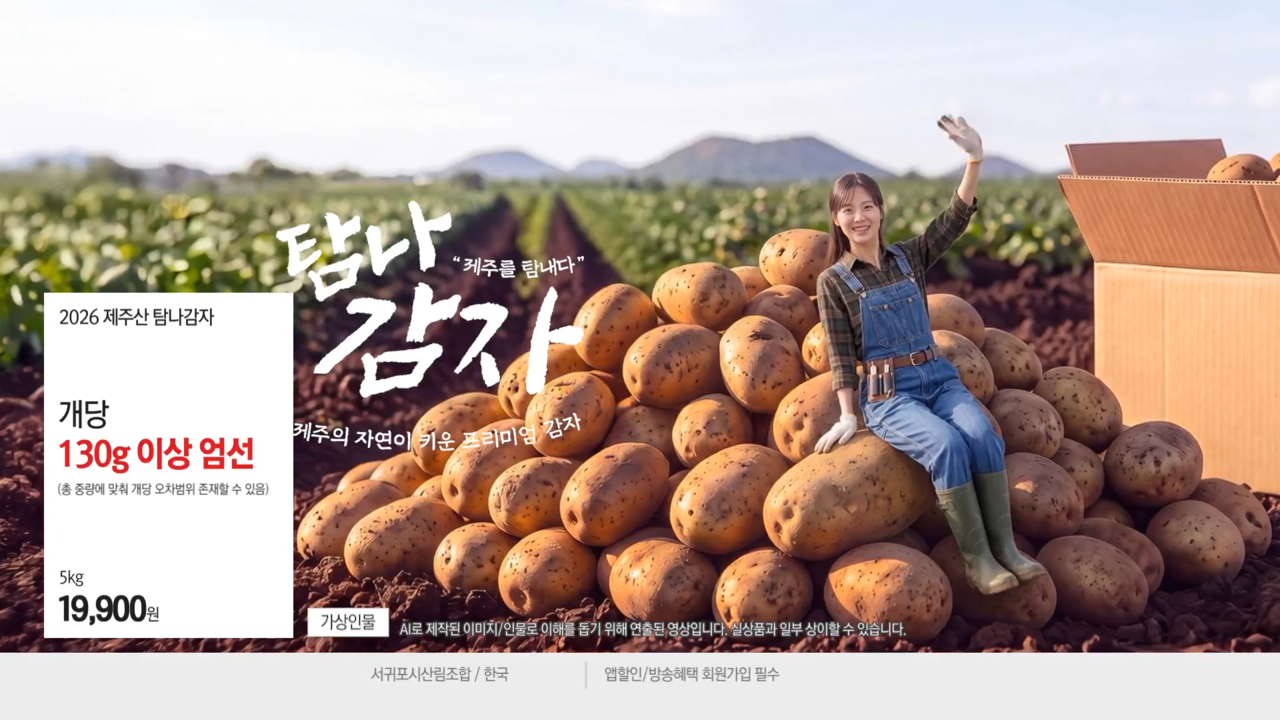
Food comes first for a practical reason: growing conditions, soil and distribution are hard or expensive to stage in a studio, and Hyundai says generated visuals can explain those details without a second shoot or physical props. A retailer can now depict an environment that used to require another camera day. That changes the production economics; it does not remove the duty to check whether the depiction matches the product in the box.
Why are the two headline numbers easy to misread?
Short answer: one number is about supplier costs, the other about target attainment — neither is a profit figure, and neither proves AI made people buy more.
At least 80% lower specified supplier costs: in a trial, expenses for sample preparation, supplementary video production and related work fell by that much, per Hyundai Home Shopping. The boundary matters — this covers participating suppliers' preparation expenses, not the retailer's complete production budget, and there is no breakdown of software charges, internal labor, review time or correction costs. A real number, but not a total-cost number.
Sales reached 120% of the target: a company-reported measure of hitting a goal the company itself set, not a 120% increase in sales. Beating your own target does not establish the incremental effect of AI; a fair comparison would need matched product, price, audience, airtime and a comparable conventional program. Neither those details nor the trial sample size was disclosed.
One voice is on record: Lim Soo-jin, head of broadcast production at Hyundai Home Shopping, said viewer feedback indicated that "information such as growing conditions and cooking examples helped them decide whether to buy." That points to the intended customer benefit — and it remains company-reported feedback rather than an independently measured conversion result.
Three common misreads, in one list:
- "120% of target" means sales beat an internal goal; it is not a 120% growth figure.
- "Labeled as AI" means disclosed, not verified — a label says how content was made, not that the facts in it are accurate.
- "One good trial" proves the pipeline ran; it does not prove the method beats a conventional program.
Does Korean law already require an "AI made this" label?
Short answer: yes — the duty has been live since January 22, 2026. South Korea's AI Basic Act requires products and services built on generative AI to be clearly labeled, through a human-readable notice or a machine-readable watermark; law firm Kim & Chang's client alert details the Article 31 obligations. A fully generated sales broadcast sits squarely in that territory, so in Hyundai's home market disclosure is now the baseline, not a differentiator. The practical shift: once viewers can see "this was generated," the contest moves to whether each scene is tied to checkable facts. Disclosure and verification are different jobs.
When does a generated image stop being illustration and start being a claim?
Short answer: when shoppers read it as product evidence — and the two best-known AI advertising plays sit on opposite sides of that line. Fresh Step's talking-cat films use generated characters to make a product benefit memorable, an obviously comic device nobody mistakes for footage. The Hyundai use case is assigned a different job: to explain a product in enough detail to support a purchase decision inside a sales program. They are distinct formats and do not supply comparable cost benchmarks.
| Example | Creative job | What it actually establishes |
|---|---|---|
| Fresh Step talking-cat films | Use generated characters to make a product benefit memorable | A brand-specific advertising production approach |
| Hyundai AI-REAL | Generate a full sales presentation and illustrate product information | A retailer-specific broadcast production approach |
Enforcement is no longer hypothetical. In a case published by China's Shandong High Court, a clothing company used AI-generated images as its only product pictures, passed them off as real shots, and was found to have committed consumer fraud — the buyer won a refund plus tripled compensation totaling 1,233 yuan. That is a Chinese ruling under Chinese law, not a Korean one, but the pattern travels: the moment a generated image is read as "what the product actually looks like," an illustration becomes a claim, and the undisclosed version is the expensive one.
Should your team try this now? A five-point checklist
Short answer: worth testing if you can name the unit of savings and the person who signs off on facts; risky if you cannot.
- Define the unit of savings. Hyundai's disclosed result concerns selected supplier preparation costs. Build a baseline covering generation, review, corrections and deployment before comparing any vendor's claim.
- Separate illustration from evidence. A generated shot of soil or distribution can make an explanation easier to follow; it stays useful only if the underlying facts are verified and the image is clearly presented as illustrative.
- Measure the customer decision. Hitting a target is operational. To argue the creative method improves purchases, you need a matched comparison of product, price, audience and airtime.
- Keep human sign-off in the loop. It is the same pattern we saw when three AI agents ran a live ad campaign while humans kept the keys in Singapore: generation is cheap, judgment is not optional.
- Set the tripwire in advance. Decide what pulls a program off air — a misstated fact, an unverifiable image — the same breaker logic we applied to unattended AI that touches real customers.
Hyundai says the expansion runs from agricultural products, meat and seafood toward processed foods and household goods. The announcement does not reveal the human approval process, nor does it establish that other retailers can buy AI-REAL as a commercial software service.
FAQ: quick answers before you decide
Did AI really generate everything, host included?
Yes — per the November 15 announcement, AI-REAL generates the program's voice and video without a live on-screen host or a camera shoot. The November 16 kiwi program is the first regular airing.
Is the 80% figure the whole production budget?
No. It covers specified supplier costs — sample preparation, supplementary video production and related work. Total production costs were not disclosed.
Does 120% of target prove AI ads sell better?
Not on its own. It is a company-reported target attainment figure, with no disclosed sample size and no independent conversion measurement.
What should you watch next?
The stated cadence of at least one AI-generated program a month, and whether Hyundai Home Shopping publishes anything on its approval process as the format moves toward processed foods and household goods.
The usual expectation is that cheaper content creates room for more content. A sales broadcast exposes another possibility: the flexibility could go into explaining the same product more carefully — same kiwi, better questions answered. Which leaves the open question this rollout hands us: when a channel can generate any scene it needs, who is the named person signing off that the scene matches what is actually in the box?
Sources
- The Korea Herald — "Hyundai Home Shopping to debut fully AI-generated sales show" (November 15, 2026): https://www.koreaherald.com/article/10937399
- Chosun Biz — "Hyundai Home Shopping launches fully AI-produced sales broadcasts" (November 15, 2026): https://biz.chosun.com/en/en-retail/2026/11/15/ME5W32XLHRDBFJVPH27X6UIEDI/
- Kim & Chang — "Recent Developments in AI Basic Act" (January 2026): https://www.kimchang.com/en/insights/detail.kc?sch_section=4&idx=33805
- Shandong High Court — published case summary, AI-generated images presented as real product photos: https://www.sdcourt.gov.cn/dyzy/372897/372899/44606647/index.html
- Hyundai Home Shopping announcement, November 15 (company disclosure as cited above)