
Why Global Chip Sales Surged in Every Region at Once — and What the AI Memory Crunch Means for You
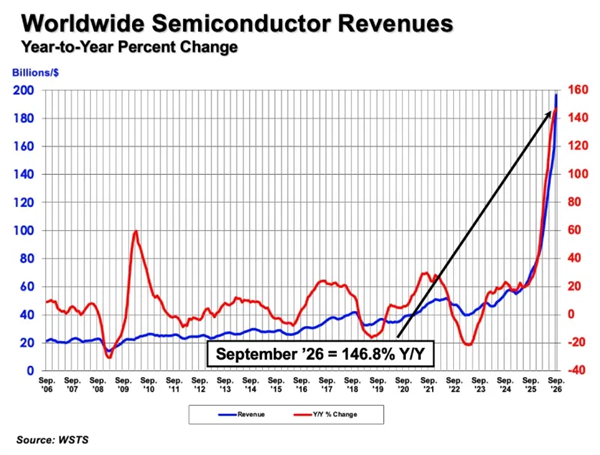
One cause, two engines: AI data-centre construction and a severe memory shortage are lifting chip demand everywhere at the same time. In September alone, every major region posted steep year-on-year growth — led by the Americas at 191.7% — while global sales rose more than 20% from the previous quarter for the third consecutive quarter. The Semiconductor Industry Association (SIA) expects this compute-and-memory cycle to run into 2027. Outside the fab, that translates into pricier laptops, phones and servers.
What exactly happened in September?
Every region that SIA tracks grew, and it grew hard. The benchmark is the monthly figure compiled with the World Semiconductor Trade Statistics (WSTS) organisation, expressed as a three-month moving average.
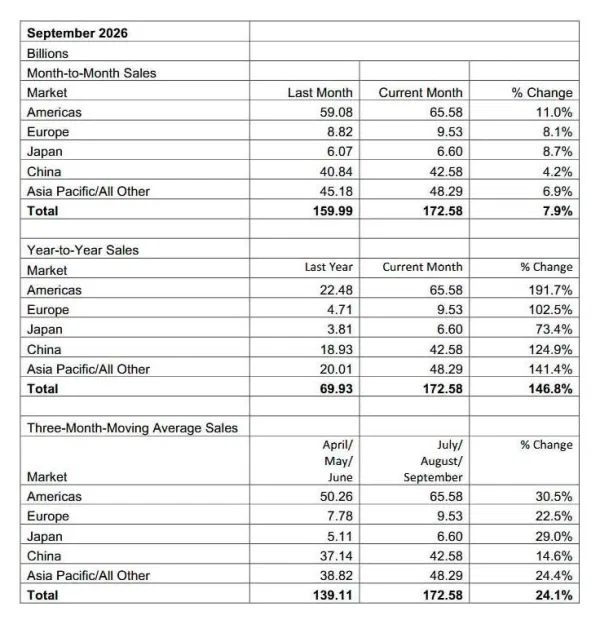
| Region | Year-on-year growth |
|---|---|
| The Americas | 191.7% |
| Asia-Pacific and other regions | 141.4% |
| China | 124.9% |
| Europe | 102.5% |
| Japan | 73.4% |
The scale matters as much as the percentages. SIA put September sales at $172.6 billion, up 146.8% from September 2025 and 7.9% from August 2026, while third-quarter 2026 sales reached $517.7 billion, up 24.1% from the second quarter. In dollar terms the Americas alone sold roughly $65.6 billion of chips in September, ahead of Asia-Pacific and other regions at about $48.3 billion and China at about $42.6 billion; Europe sat near $9.5 billion and Japan near $6.6 billion, according to the SIA release.
Why do the growth rates look so extreme?
Because three effects are stacking. First, the base: September 2025 totalled about $69.9 billion, so any strong month reads as a triple-digit jump. Second, the measurement method: a three-month moving average smooths noise but also carries momentum forward, which is why a quarter of the reading is roughly the average of three very hot months. Third, price. This cycle is not mainly about selling more units — it is about selling scarce ones dearer. Memory is the clearest example: when high-bandwidth memory absorbs fab capacity, ordinary DRAM and NAND reprice upward, and revenue grows faster than shipments.
What is really driving it?
AI infrastructure spending is the engine, and it has not hit a wall. Omdia forecast that global semiconductor revenue in the third quarter of 2026 would break $500 billion, and that cumulative revenue for the first three quarters would already stand more than 50% above the total for full-year 2025.
Underneath that sits a supply squeeze that research firms have quantified. Goldman Sachs estimates the supply-demand gap for DRAM, NAND and HBM in 2026 at 4.9%, 4.2% and 5.1% respectively — the widest since 2011. SK Hynix and Micron have publicly stated that their HBM output for 2026 is completely sold out, with some customers beginning to secure supply for 2027 to 2028. That is a seller's market converting AI ambition directly into booked revenue.
A useful analogy: think of wafer capacity as a fixed amount of bakery shelf space. High-bandwidth memory and DDR5 modules are the large custom cakes — they take more time, more layers and more trimming per unit sold, so fewer loaves of everyday bread reach the counter. That is why an AI data centre purchase can end up repricing a laptop you were about to buy.
Spending projections reinforce the durability of the demand side: J.P. Morgan Global Research estimates global AI capital expenditure at about $900 billion in 2026 and $5.5 trillion by 2030, most of it flowing into chips, servers, networking and the power systems that host them.
Who pays for a seller's market? Consumers first
Households, not hyperscalers, absorb most of the squeeze, because they cannot negotiate supply contracts.
- Higher list prices. Gartner estimated in February 2026 that combined DRAM and SSD prices would climb roughly 130% by the end of 2026, lifting PC prices about 17% and smartphone prices about 13%.
- Fewer units bought. The same research projects global PC shipments down about 10.4% and smartphone shipments down about 8.4% in 2026.
- Quieter spec cuts. Memory-heavy configurations — 16GB laptops, 512GB phones, mid-range gaming rigs — are the ones trimmed first, a dynamic IDC has flagged across the smartphone and PC roadmaps.
- Longer waits for business kit. Server, storage and networking gear now follows allocation logic: priority goes to customers who commit far in advance.
- A hotter second-hand market. Older devices with adequate memory hold value longer, since buyers avoid paying today's component premium.
How long can this run — and what could break it?
SIA's read is that it runs into 2027. President and CEO Michael Robbins said the global chip market grew sharply through the third quarter, with sales up more than 20% quarter-on-quarter for the third consecutive quarter and all major regions posting strong year-on-year gains — evidence, in his words, of the irreplaceable role semiconductors play in driving innovation, productivity and economic competitiveness. He added that AI infrastructure investment shows no sign of slowing, making it highly likely this cycle extends to 2027.
Manufacturers agree. Samsung said in a press release on 29 October 2026 that it expects memory demand to far exceed supply in 2027, after telling analysts during its August earnings call that shortages would worsen versus 2026 and persist into 2028. SK Hynix CEO Kwak Noh-jung has described 2027 as potentially the worst supply crunch the memory industry has seen, with demand outstripping supply beyond 2030.
Three risks could still cut the cycle short — and this part is our analysis, not a sourced forecast:
- A capex pause. Microsoft and Alphabet reported capital spending below analyst expectations in late October 2026, a reminder that build-outs are budget decisions that can be deferred by one boardroom.
- Simultaneous capacity additions. When several memory makers expand at once, new supply tends to land in the same window; if that arrives in 2027, pricing power erodes quickly.
- Demand destruction feeding back. The shipment declines projected for PCs and phones shrink the volume base that non-AI chips depend on, narrowing where growth can come from.
Common misconceptions
- "Chip sales are up because everyone is buying more gadgets." Growth is concentrated in AI infrastructure and memory pricing, while device volumes are forecast to fall.
- "A 191.7% jump means the Americas sold twice the chips." It reflects revenue against a weak September 2025 base, not unit volume.
- "Once shortages hit, prices snap back fast." New fab capacity is a multi-year commitment, which is why both Samsung and SK Hynix are pointing at 2027 and 2028 rather than a mid-2027 fix.
- "This only concerns the tech sector." Chips now price into cars, appliances, medical kit and the cloud services your employer runs.
Frequently asked questions
Is the semiconductor upswing about AI or about memory?
Both, and they are the same story from two angles. AI accelerators need HBM and DDR5; the capacity devoted to those parts is capacity not available for commodity memory, so general-purpose DRAM and NAND reprice upward too.
Why did every region grow at once?
Because the demand is a single global build-out. Data centres in the Americas and Asia absorb wafers produced in Asia and equipment sold worldwide, so a US design order and a Chinese module order compete for the same scarce supply.
Should I buy a laptop or phone now or wait?
If your device is failing or you need it for work, buy; component tightness is forecast to persist well into 2027, so waiting does not reliably mean cheaper. If you can wait, look for current-generation models already in channel stock, and avoid paying a premium for memory capacity you will not use.
Will this affect my company's IT budget?
Expect it to. Longer refresh cycles, higher per-unit prices and allocation-based lead times are the standard symptoms of a memory shortage, and they hit small and mid-sized buyers hardest because they order last.
Does record revenue mean record chip supply for consumers?
No. Record sales measure money, not availability. In a seller's market the same wafer output generates more revenue while each end product carries a higher memory bill.
Action checklist
- Consumers: lock in a device purchase inside the next quarter rather than planning around a price drop; compare 8GB/12GB and 128GB/256GB tiers for real value, and consider certified refurbished.
- IT and procurement teams: publish refreshed hardware budgets using roughly +17% for PCs and +13% for handsets as planning anchors, and pre-book server and storage orders with 2027 delivery windows.
- Product and ops teams: treat memory and storage as a line-item risk in bill-of-materials planning; redesign only where a cheaper configuration does not damage the user experience.
- Everyone: track the monthly SIA release and quarterly guidance from major memory makers — those two signals tell you more about the cycle than any single product announcement.
Sources
- Semiconductor Industry Association, monthly and quarterly global sales data: semiconductors.org
- Gartner press release, 26 February 2026, on surging memory costs and PC and smartphone shipments: gartner.com
- IDC resource centre on the global memory shortage and its effect on smartphone and PC markets in 2026: idc.com
- J.P. Morgan Global Research on AI capital expenditure outlooks: jpmorgan.com
- Reuters on SK Hynix's outlook for the memory supply crunch, July 2026: reuters.com
- PYMNTS on Samsung's warning that AI memory shortage worsens through 2027: pymnts.com
- CNBC on Microsoft and Alphabet capital expenditure coming in below estimates, 29 October 2026: cnbc.com
Analysis for MyTechDailyNews by Sarah Chen, Tech Daily. Story tips and corrections: hello@techdaily.com.