
2026 AI Agent Stack Choices: A MyTechDailyNews Comparison for Martech Users
By Sarah Chen · MyTechDailyNews General desk
The practical answer is simple: compare AI agents by who controls them, what data they touch, and how much customer-facing risk they create. In 2026, martech stacks are not just collecting more tools; they are becoming decision systems that either assist marketers, speak with customers, or help buyers shop. That distinction is the fastest way to separate useful upgrades from hype.
What are the three AI agent domains readers should compare?
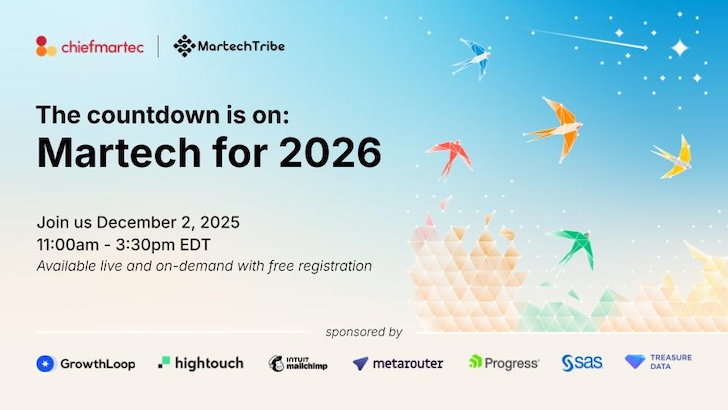
A useful comparison starts with one question: is the AI working for the marketer, speaking for the brand, or working for the customer? The latest annual martech review treats this as three domains, and each has a different payoff and failure mode.
- Agents for Marketers. These help design, produce, and analyze campaigns behind the scenes. Best for teams drowning in reports, briefs, and creative testing. The hidden cost is data quality: a weak stack gives the agent weak context.
- Agents for Customers. These are controlled by marketers and touch users directly, such as service agents, AI SDRs, or website concierges. Best for response speed and personalization. The trade-off is that mistakes become customer-facing.
- Agents of Customers. These are buyer-side tools used for research, evaluation, negotiation, and purchase. This is where real disruption appears because brands no longer fully control the conversation. Answer-engine optimization, or AEO, is only an early warning signal.
Why is this annual report useful for a general tech reader?
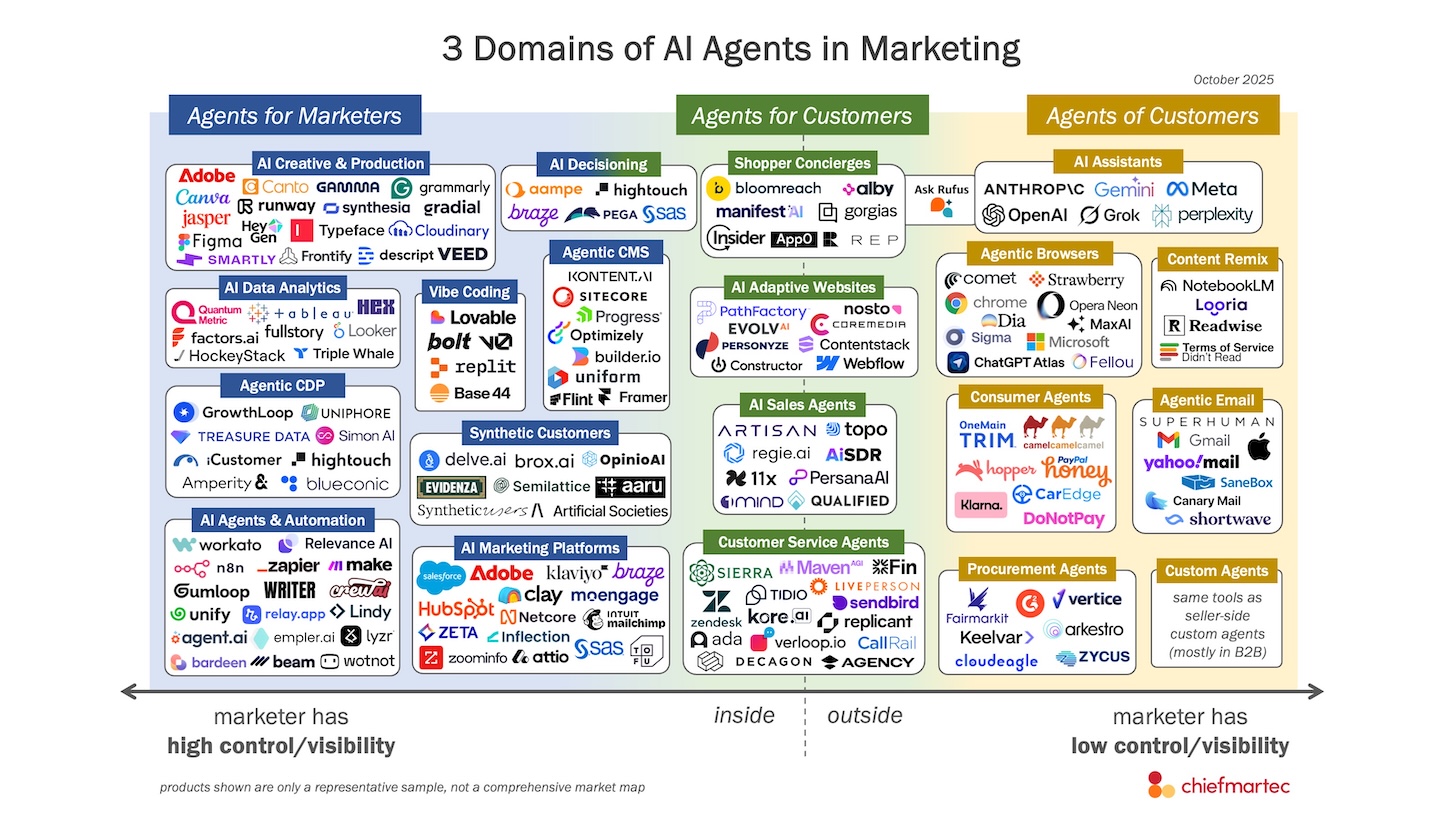
Every December, for the past few years, Frans Riemersma and his co-author have tried to turn scattered product launches into a practical view of what is really happening in martech before the New Year. The latest edition, Martech for 2026, is scheduled for Tuesday, December 2. Instead of chasing speculative forecasts, it extrapolates current real-world patterns across the next 6-12 months. Frans remains central to the research, and readers can access a 100+ page report plus an hour-long presentation after free registration. The work is supported by GrowthLoop, Hightouch, Intuit Mailchimp, MetaRouter, Progress, SAS, and Treasure Data.
How should ordinary tech readers judge whether AI agents matter?
Start with adoption shape, not marketing demos. Gartner predicts that up to 40% of enterprise applications will include integrated task-specific agents by 2026, up from less than 5% in 2025. That change matters because agents are becoming part of everyday software, not just a novelty layer.
The tool universe is also changing. The 2026 Marketing Technology Landscape Supergraphic counted 15,505 products, up only 0.79% from the prior year, with 1,488 added and 1,367 removed. For a stack buyer, that is a clear sign: fewer shiny logos, more consolidation pressure. A CMSWire report on martech spend also notes that, according to Gartner's 2026 CMO Spend Survey, martech fell to 19.4% of marketing budgets in 2026, its lowest share in five years and down from 26.6% in 2021.
In plain terms, the comparison for 2026 is no longer “which tool has AI?” It is “which agent improves outcomes enough to justify the extra governance, integration, and review work?”
Quick comparison: which martech AI agent should you choose first?
| Agent type | Best scenario | Hidden cost | Decision rule |
|---|---|---|---|
| Agents for Marketers | Campaign planning, creative briefs, reporting, and analysis | Fragmented data sources and weak internal context | Choose first when the team needs speed more than perfect automation |
| Agents for Customers | Service, lead response, product guidance, and website help | Brand risk, escalation design, and conversation memory | Choose when latency matters and you can define clear handoff rules |
| Agents of Customers | Buyer research, comparison shopping, and assisted purchases | Less direct control over how brands are represented | Monitor continuously; optimize for being selected, not just being seen |
What do consumers expect from AI concierges and buyer-side agents?
Consumer appetite is real, but it is not unconditional. Adobe's 2026 AI and Digital Trends report says 43% of customers would be willing to interact with a brand's AI personal concierge or agent if the service is offered. That is enough to make customer-facing agents a mainstream test case, not merely a niche experiment.
The buyer-side picture is even broader. Gartner's Strategic Predictions for 2026 says by 2028, 90% of B2B buying will be AI agent intermediated, pushing more than $15 trillion of B2B spend through AI agent exchanges. For a general reader, that suggests the next phase of disruption is not just better chatbots; it is who gets to see your brand, compare it, and decide for you.
Common misconceptions about AI agents and martech stacks
- Misconception 1: More agents means more innovation. In many stacks, more agents simply means more permissioning, logging, and review work.
- Misconception 2: A customer-facing agent is just a smarter chatbot. The moment an agent acts on behalf of a brand, it needs escalation paths, audit trails, and clear scope.
- Misconception 3: AEO fixes buyer-side agents by itself. Structuring answers is useful, but the deeper issue is whether the brand's data, claims, and product facts are machine-readable and trustworthy.
- Misconception 4: AI either replaces SaaS or it does not. In practice, the report examines three possibilities: augmentation, replacement, or entirely new use cases inside existing stacks.
- Misconception 5: Context is optional. “Context engineering” is becoming the control layer: choosing which data sources feed an agent and which ones add noise. That is why platforms that connect CRM, data, and content governance may become more important, not less.
Action checklist before adopting an AI agent stack
- Map the agent to one of the three domains: marketer-side, customer-facing, or buyer-side.
- Write down the data sources the agent will use, including CRM, support history, product docs, and ad platforms.
- Decide whether the agent should recommend, execute, or only summarize. That boundary is the core risk control.
- Build a human handoff rule for anything involving refunds, medical, financial, legal, or angry customers.
- Measure time saved, error reduction, and response quality, not only engagement.
- Compare consolidation value: fewer tools with better integration may beat a bigger AI catalog.
- Recheck the stack every quarter, because the mix of augmentation, replacement, and new use cases is moving fast.
FAQ: what readers ask before upgrading martech for AI agents
Do AI agents replace marketing platforms?
Not as a blanket rule. The annual review is more cautious: it asks whether AI augments existing applications, replaces them, or creates entirely new use cases. For most teams in 2026, the safer assumption is hybrid change, with the biggest impact coming from workflow speed and data access.
Which AI agent type is riskiest?
Agents for Customers are the riskiest for brand reputation because they interact with people directly. Agents of Customers are the hardest to control because they sit outside the company’s own stack and shape buying decisions.
Is this topic only for marketing technologists?
No. General tech readers should care because agents are becoming the interface between consumers, companies, and software. That affects search, customer service, shopping, privacy expectations, and even how trust is earned online.
What is the simplest way to judge an AI agent upgrade?
Ask three things: who controls it, what data it depends on, and what happens when it is wrong. If a vendor cannot answer those clearly, the upgrade is probably still a prototype, not a production-ready stack choice.
What should ordinary users do now?
Treat AI concierges and shopping assistants as tools that can save time but still need verification. For high-stakes purchases, compare at least one independent source before relying on an agent’s recommendation.
Reference sources
- Gartner: enterprise applications and task-specific AI agents
- Gartner: Strategic Predictions for 2026
- Chiefmartec: 2026 Marketing Technology Landscape Supergraphic
- Adobe: 2026 AI and Digital Trends report
- CMSWire: martech budget share decline
- MarTech: context engineering and governed data sources
This General desk piece is from MyTechDailyNews, published by Tech Daily. For corrections or product-news tips, contact hello@techdaily.com.