
Unmanned Delivery Vans Are Everywhere in 2026: A Practical Field Guide for Commuters, Shopowners and Fleet Buyers
By Sarah Chen, MyTechDailyNews technology desk
If a driverless delivery van freezes in your lane in 2026, the correct response is boringly simple: stop, hold your distance and call the operator hotline printed on its body — never touch, push or climb on it. These small electric cargo boxes have spread so fast because their running cost collapsed: about 2,500 yuan a month, against 7,700 yuan for a conventional van plus driver. This guide explains who may legally run them, who pays after a crash, what a fleet really costs and how to share the street with them.
What exactly is an unmanned delivery van, and why did 2026 become its breakout year?
Short answer: it is a pre-mapped, L4-class electric cargo box that shuttles parcels between two fixed logistics points with no one on board, while a remote operator watches several or even a dozen-plus vehicles at once.
The idea is not new. As early as ten years ago, companies with parcel and food-delivery businesses — JD.com, Cainiao and Meituan — were already experimenting, but the technology was immature and no legal framework existed, so the robots mostly circled inside campuses, gated communities and industrial parks. Public-road rights appeared in 2021, and only then did these vehicles leave the beginner zone.
What changed is scale and visibility, and recently the two have fed each other. Reviewer Shi Chao noted that in Hangzhou the little vans are multiplying in plain sight — and their on-street behaviour is funnier than any marketing film. In one widely shared clip, a pack of dogs surrounds a stalled van; some viewers call it a three-on-one stand-off, others joke it is puppies meeting an electronic gadget for the first time. Shi Chao's quip was that the vans' CPUs seem to house Lu Xun, forever processing the writer's line that there were no roads on the earth at first, and roads exist because many people walk on them. Accordingly, a van may slip into the motor lane, then the bicycle lane, then stop dead in the middle of the road, occasionally even cruising along the pavement.
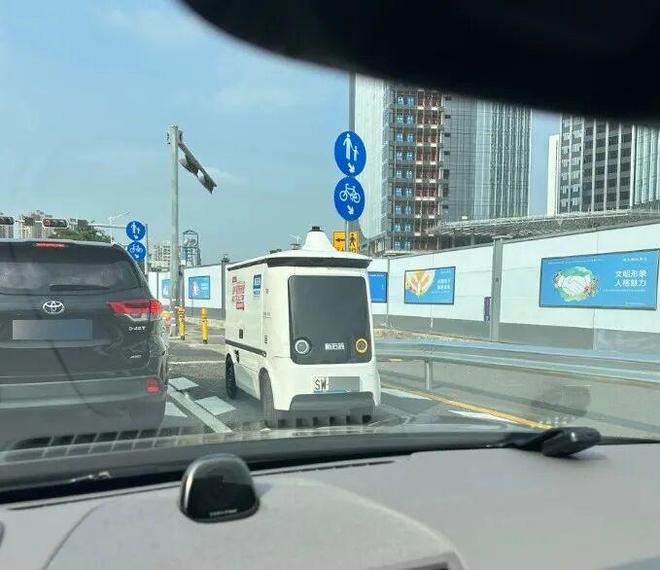
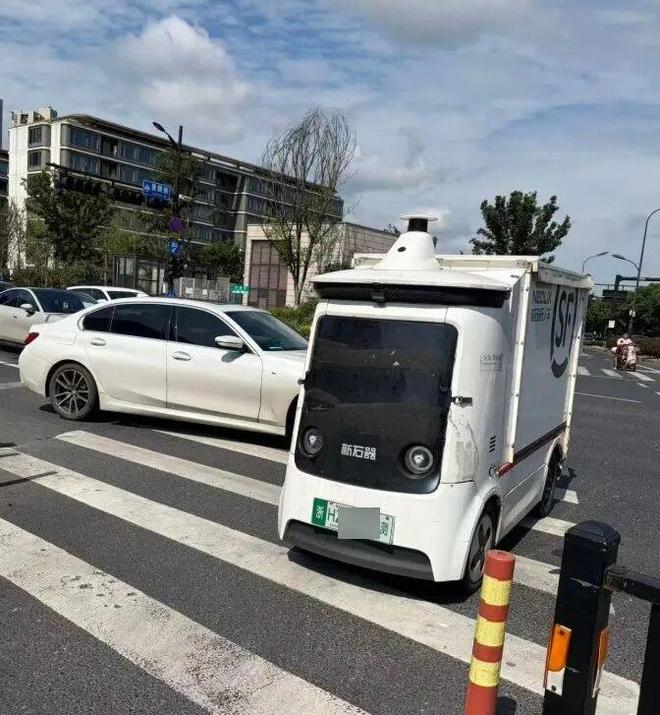
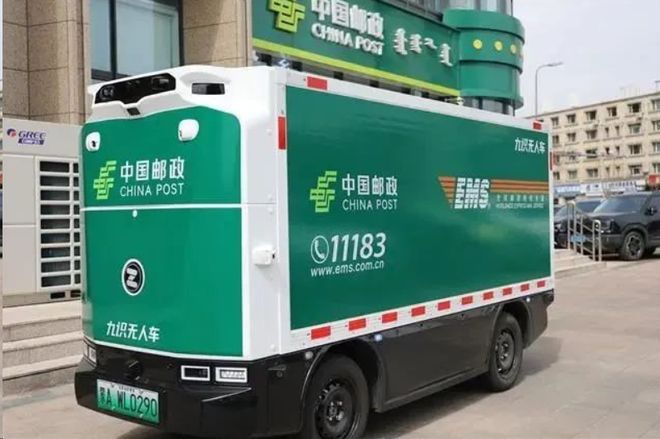
Money followed the memes. A few days ago, self-driving van maker Neolix closed a Series E round of nearly $400 million, pushing its cumulative funding past 10 billion yuan. Industry statistics point the same way: China Post, the largest operator of such vehicles domestically, reported at the end of July that it had deployed nearly 5,000 vehicles across 31 provinces and 263 cities and had already carried more than 130 million parcels. To date, the national picture is bigger still — the State Post Bureau said in August 2026 that more than 16,000 driverless delivery vehicles and over 400 drones were in use across the country (Xinhua, English edition).
Can it drive on any road it wants? How road rights really decide where vans appear
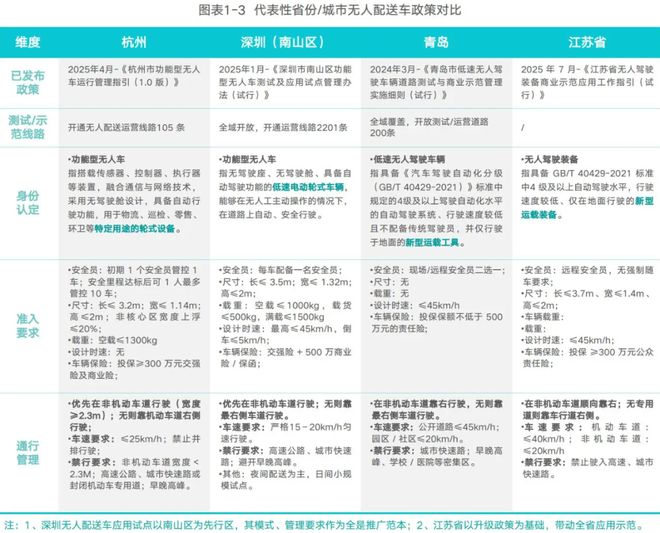
No. Road rights are the switch that turns the whole business on or off, and they are granted route by route rather than handed over for a whole municipality.
These vans carry registration plates and must obey traffic rules like any other vehicle. But the detailed terms are still set one city at a time: local rules typically constrain vehicle dimensions, maximum speed, the ratio of remote safety operators to vehicles and the required insurance — with cover in the million-yuan class. When a collision happens, traffic police issue a liability determination just as they would for a human driver.
Two practical caveats matter for readers. First, coverage figures can overstate what you will actually see: many listed regions open only a single district or a couple of approved corridors, not the entire city. Second, even a permitted van is time-restricted. Courier staff told Shi Chao that their station once ran several vans, but traffic police now hold them back during the morning and evening rush hours and during school drop-off and pick-up times, so they appear on the road only in limited windows.
Regulation is starting to converge. Since July 1, 2026, a national public-security industry standard, GA/T 2388-2026, has set common traffic and speed baselines: 20 km/h on city side roads and bicycle lanes, 30 km/h on main and secondary arterials, a ban on expressways and elevated roads, night running restricted to closed parks and approved corridors between 22:00 and 06:00, mandatory stop-and-look at signals-free junctions and automatic suspension in severe weather (Sina Finance report). It is a recommendatory standard rather than a law, so local permits still decide where a van may roll.
It froze in the middle of the road: five steps for drivers, riders and pedestrians
Treat a stalled van as a live hazard, not as a curiosity. Follow this order:
- Slow early and leave a gap. These vehicles brake hard and start without warning, so keep more distance than you would behind a human driver.
- Do not touch it. No shoving it aside, no opening the cargo door, no climbing on top. Shi Chao's advice is blunt: leave the vehicle alone, and stay well away from it personally — safety first, jokes later.
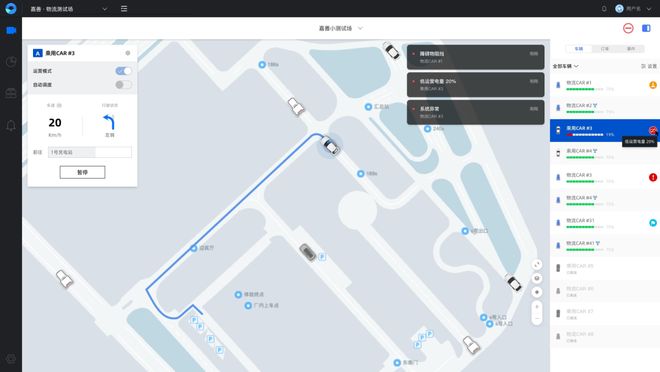
- Find the operator number on the bodywork and call it. Fleets run control rooms that show where each van is, whether it is on task, whether an obstacle blocks it, and whether the system has faulted or the battery is low.
- If it blocks a lane, hand it to traffic police. Report location and direction of travel; officers contact the operating company rather than letting bystanders solve it.
- Watch children and pets. A van's sensors expect pedestrians to behave predictably; a dog running around the wheels — as in the viral Hangzhou clip — or a child stepping out from behind it is exactly the scenario that freezes the algorithm.
Expect awkwardness in the process even when nothing is broken. As one courier put it to Shi Chao, the vans make life easier, but "if it hasn't come back after ages, you have to go out and find it and see where it got stuck". Stations have learned this the hard way: a van that pauses too long simply stops being cute for the staff who own the deadline.
Liability is the other loose end. An autonomous van has no driver sitting in the seat as the obvious responsible party, so even where insurance exists, establishing fault after an incident can drag on. China is moving on this: in August 2026 the country proposed adding a dedicated chapter on autonomous vehicles to its Road Traffic Safety Law (Reuters). Until then, the safest personal policy is the same as the checklist above: keep your distance.
Infrastructure, not intelligence, causes many of the standoffs. A case reported in Shandong in July 2026 — a driverless van held at a car-park exit because nobody could pay a two-yuan barrier fee — shows how a gate, a payment terminal or a speed bump with no machine-readable rule can neutralise an otherwise smooth route. The same point was made by White Rhino's chief technology officer, Xia Tian, who argued in an interview that fleets are still spread thinly enough for the public and regulators to tolerate a stranded van, and that tolerance will fall sharply once vehicles are counted in the hundreds of thousands.

Why does it spread so fast? Run the cost arithmetic
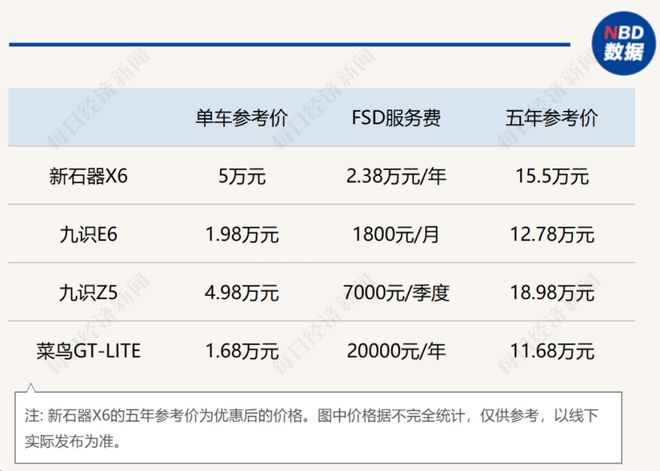
Because it is genuinely cheap on the repetitive legs of a delivery route. In 2018 a driverless logistics vehicle was still a million-yuan-class purchase. Last year a bare vehicle cost 20,000–30,000 yuan, with an annual service fee of just over 20,000 yuan; amortised over five years, typical total ownership sits around 120,000 yuan.
A brokerage calculation converts that into monthly numbers you can compare with a van and a driver:
| Item | Driverless logistics van | Traditional logistics van |
|---|---|---|
| Monthly cost | Around 2,500 yuan, including vehicle depreciation, FSD service fee and electricity | 7,700 yuan, likewise including depreciation, driver wages and fuel |
At scale the arithmetic becomes a boardroom issue: for a giant such as SF Express, last-mile vehicle fleets run to tens of thousands or even more than 100,000 units, so the saving is real cash.
The catch is that those figures apply to entry-level models used for station-to-station shuttling. County-to-county or village-to-village legs need higher-specification vans — which come at another price. Independent industry surveys published in July 2026 put the all-in monthly cost of mainstream 5–6 cubic-metre models at roughly 4,000–5,500 yuan against 7,000–9,000 yuan for a human-driven equivalent, and estimated per-parcel cost on express shuttle runs had fallen from 0.31 yuan to 0.16 yuan (sector analysis). Read them as a range around the broker figure, not a replacement for it: cheaper vehicles and shorter routes flatter the numbers, while insurance, remote supervision and retrieval trips push them back up.
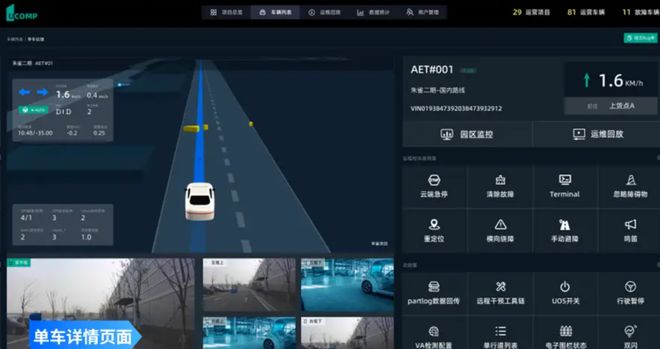
Operating them is deliberately simple. Routes are pre-loaded; staff put parcels inside and the van departs. A remote safety operator supervises several or a dozen-plus vehicles, taking over when something goes wrong. The control room shows position, task status, obstructions, system faults and battery level.
The per-vehicle console even lets an operator honk the horn manually — which explains a fair share of the street-level comedy.
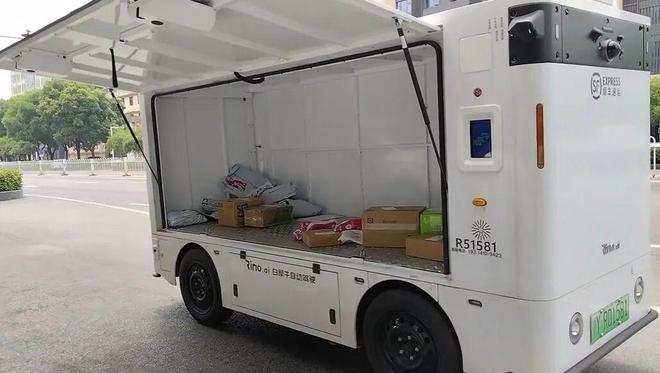
Is parcel delivery all it does? The push to become urban capacity
Not even close, which is why the industry prefers the term unmanned logistics vehicle. Jiushi Intelligence said this year that express-delivery work is now less than 40% of its fleet usage, down from about 50% in Q3 last year — meaning 60% of the driving happens somewhere else.
Think of it as a self-driving cargo box: any A-to-B hauling is fair game. Supermarket and convenience-store replenishment and on-demand logistics fit naturally.
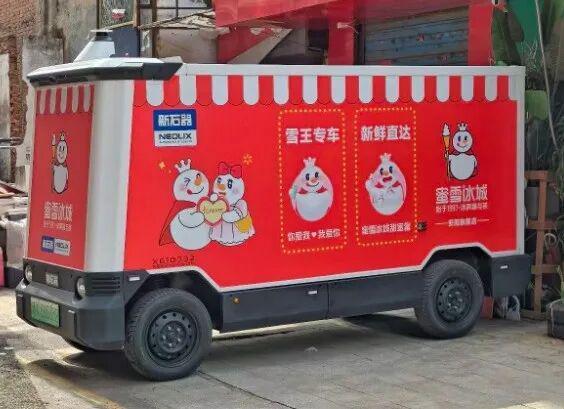
Small parcels that people previously sent by hiring a DiDi ride are an obvious candidate. Jobs humans dislike are another: delivering meals to house-bound older residents means running to more than 10 community meal points a day, hardly worth hiring a dedicated driver, so a van carries the food and volunteers hand it out.

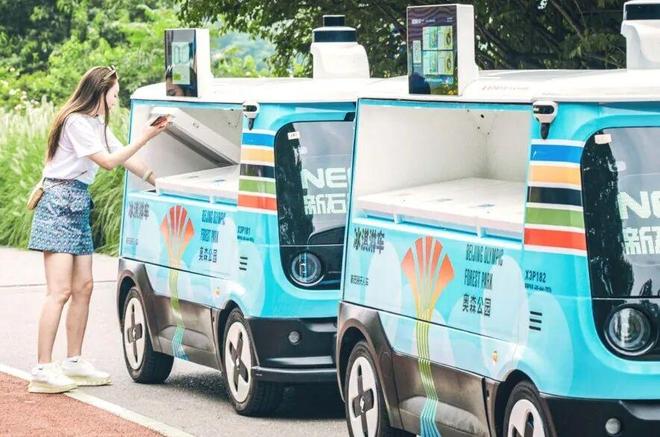
There is a retail version too: fit a freezer box and the same chassis sells ice cream in scenic areas and business parks, while the onboard screen runs advertisements.
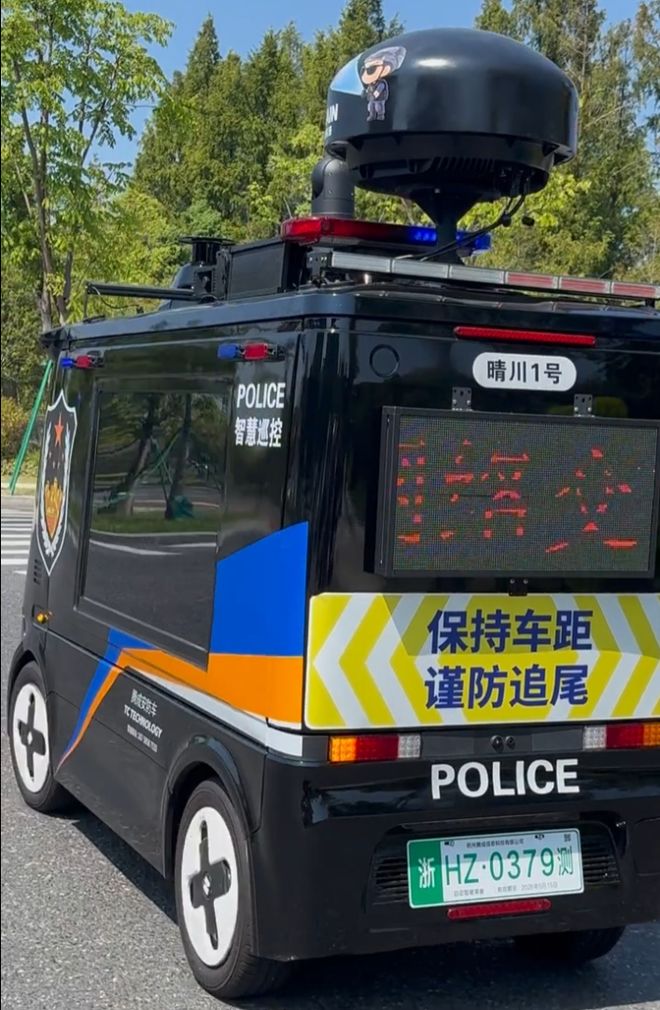
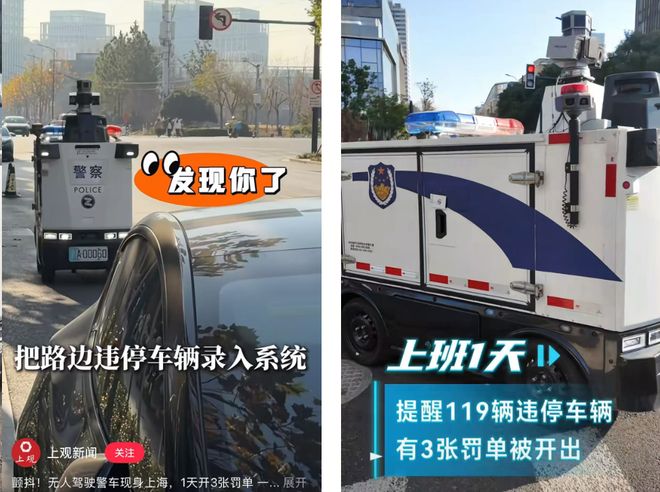
Public safety is the least discussed use. In Hangzhou's Yuhang district, autonomous police vans are a regular sight: they detect violations and send photos to the police station for human review, carry a one-touch alarm button linked directly to the police station, and store first-aid and firefighting equipment inside, which officers can unlock remotely in an emergency.
Thinking of running a fleet? Six checks before you sign
- Confirm road rights per route. Every corridor has to be surveyed and mapped in advance, filed with the operator's backend and registered with local traffic authorities before the first parcel moves.
- Model the time windows. If morning and evening rush hours and school drop-off and pick-up times are closed to you, your daily parcel capacity is the daytime remainder, not the brochure figure.
- Price the compliance items, not just the hardware. Insurance in the million-yuan class, the FSD service fee, the remote safety-operator ratio and the mandated on-board data recorder belong in the same spreadsheet.
- Audit the physical route end to end. Gates, barrier arms, docking bays, charging points and payment terminals are where driverless routes die; assign a human fallback for each.
- Agree the incident playbook in writing. Who answers the phone when a van stalls, who retrieves it, and who speaks to traffic police after contact with another road user.
- Start with the dull, repetitive leg. Hub-to-station shuttling on a fixed loop is where the payback is proven; door-to-door delivery is not the first job to automate.
Four misconceptions that still shape the coverage
- "The vehicles are clumsy because the technology is weak." In closed parks and campuses these vans avoid obstacles and complete routes reliably. The visible problems concentrate where rules, road rights and human road behaviour are unsettled.
- "One city permit means the whole city is open." Coverage lists often reflect a district or a few approved corridors, with hour-by-hour restrictions on top.
- "This is how couriers lose their jobs." The vans absorb the tiring shuttle legs, and the freed-up staff move to door-to-door delivery and collection — the part customers still judge a service on.
- "Cheap to buy means cheap to own." Purchase price is the small line item; service fees, insurance, supervision and stuck-vehicle retrieval are what decide the real monthly number.
FAQ: the questions readers actually search
Are driverless delivery vans legal on public roads in China?
Yes, where a local permit exists. They are registered, must follow traffic rules, and accidents are handled by traffic police. Rules on size, speed, insurance and supervision are set city by city, with the national industry standard GA/T 2388-2026, in force since July 1, 2026, providing a common baseline.
What should I do if one blocks my car or my driveway?
Call the operator number on the vehicle body, give the route and direction, and wait for remote takeover. Do not move the vehicle yourself; if traffic is obstructed, involve traffic police, who will summon the operator.
Who pays if a driverless van hits my car?
Liability is determined like a normal traffic accident, and operators carry high-value insurance. The practical difficulty is the absence of a driver as a single obvious responsible party, so claim handling can take longer — one reason lawmakers proposed an autonomous-vehicle chapter in the national traffic law in August 2026.
Do they deliver to my door?
Mostly not yet. The dominant pattern is station-to-station and station-to-pickup-point shuttle runs, with couriers still doing the final handover to customers.
Are these vans a China-only story?
No. Neolix won the first unmanned delivery vehicle licence issued in the United Arab Emirates for operations in Abu Dhabi and was approved to run trials in Malaysia (China Daily), while Jiushi Intelligence's integrated fleet with Cainiao exceeds 20,000 vehicles in more than 300 cities (36Kr). Analysts at Fortune Business Insights size the global autonomous last-mile delivery market at about USD 31.88 billion in 2026, up from USD 25.45 billion in 2025 — a reminder that the road-rule argument will be replayed in many countries, where sidewalk-class robots are typically required to yield right of way to pedestrians and cyclists.
What to watch next, and what you can do this week
Two checkpoints stand out. Existing vans must complete software and hardware compliance upgrades by August 2027 under the transition period attached to the new industry standard, and the proposed autonomous-vehicle chapter in the Road Traffic Safety Law will show whether accident liability stops being negotiated case by case.
For readers the action list is short: learn to recognise the orange-and-white vans in your area, photograph the operator number before you need it, teach children not to chase them, and if you run a shop or a station, price one fixed shuttle loop before considering a purchase. Overseas rollouts are worth watching too, since export markets will test whether the low-cost model survives where rules treat these machines more like pedestrians than vehicles (academic review). The vehicles stopped being prototypes some time ago; what has not caught up is the street furniture, the paperwork and our habits around them.
Spotted a driverless van behaving badly — or usefully — on your street? Send clips and location details to hello@techdaily.com and the MyTechDailyNews team will follow up with the operator.
Sources
- Xinhua (English edition), "Unmanned wheels roll out farther and faster delivery network in China" — https://english.news.cn/20260206/8fb2cdd671024b3080839248e4cd52a7/c.html
- Sina Finance, report on the GA/T 2388-2026 traffic standard for unmanned delivery vehicles, July 23, 2026 — https://finance.sina.cn/2026-07-23/detail-iniiuwta9459474.d.html
- Reuters, "China proposes road traffic law amendment with autonomous vehicles section", August 25, 2026 — https://www.reuters.com/world/china/china-proposes-road-traffic-law-amendment-with-autonomous-vehicles-section-2026-08-25/
- TechNode, Neolix Series E round of nearly $400 million, October 20, 2026 — https://technode.com/2026/10/20/autonomous-delivery-vehicle-maker-neolix-raises-nearly-400-million-in-series-e-funding/
- China Daily, Neolix approved for driverless delivery trials in Malaysia, June 30, 2026 — http://www.chinadaily.com.cn/a/202606/30/WS6a43b122a310986e2b462bf0.html
- 36Kr (English), Jiushi Intelligence financing and fleet scale after the Cainiao integration, February 25, 2026 — https://eu.36kr.com/en/p/3697934886760328
- Sector cost analysis on unmanned delivery vehicles, July 2026 — https://m.toutiao.com/article/7667549153022509631/
- Fortune Business Insights, Autonomous Last Mile Delivery Market report — https://www.fortunebusinessinsights.com/autonomous-last-mile-delivery-market-105598
- Taylor & Francis, "Regulating sidewalk delivery robots as a disruptive new technology" — https://www.tandfonline.com/doi/full/10.1080/02723638.2023.2275426