
Peak Martech in 2026? What 15,505 Products and 0.79% Growth Really Say About Your Tech Stack
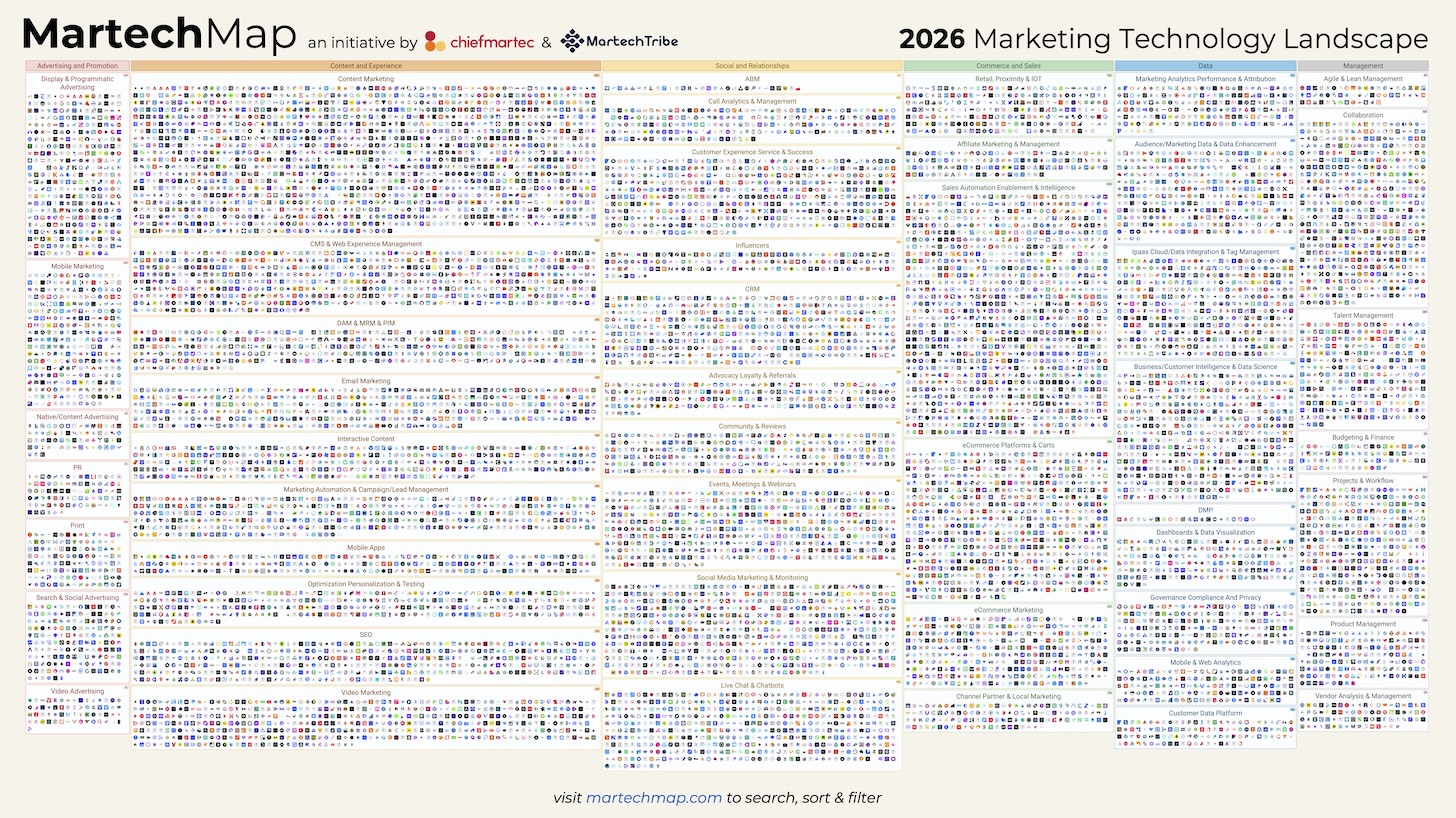
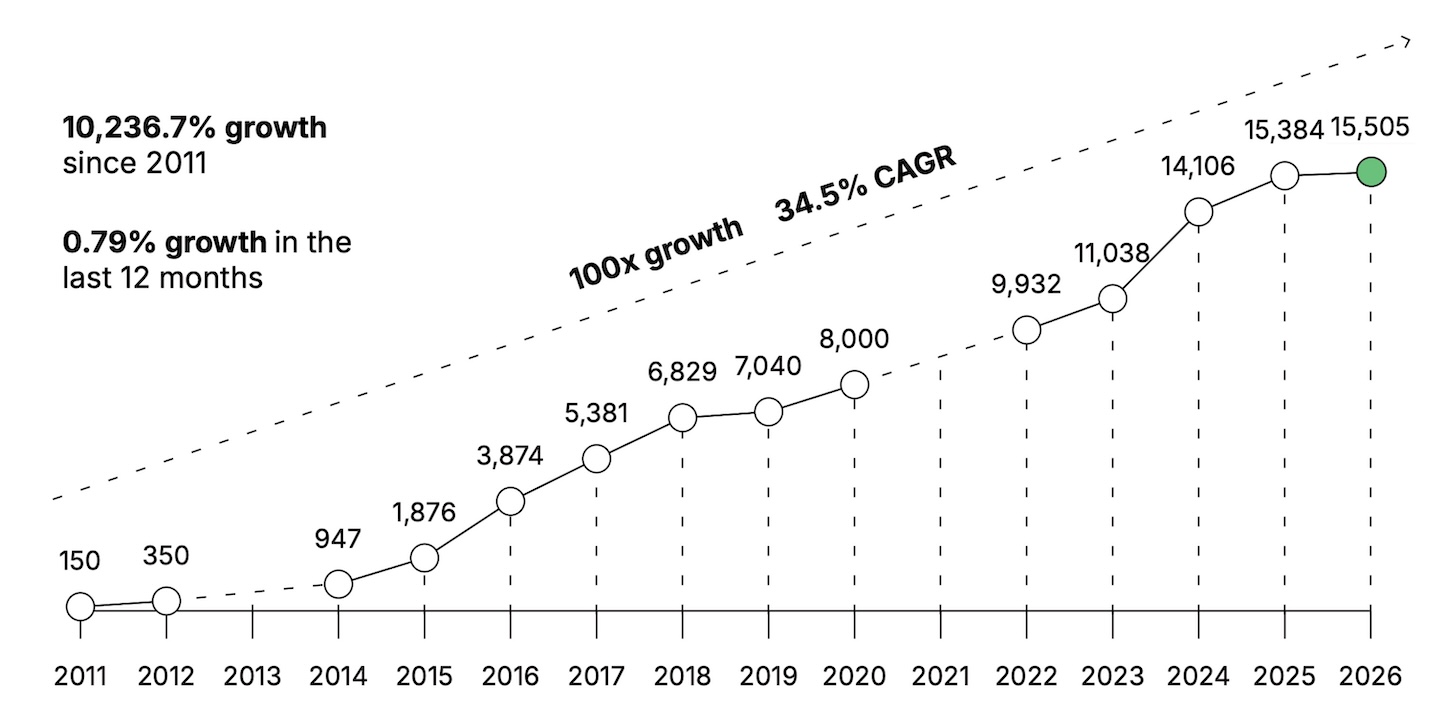
No, the marketing software market did not freeze — it traded expansion for turnover. The 2026 Marketing Technology Landscape now counts 15,505 products, just 0.79% above last year's 15,384 total, a gap of 121 net products after 15 years of non-stop growth. Underneath that flat headline, 1,488 products were added and 1,367 were dropped, meaning nearly one listing in five changed status inside twelve months.
By Sarah Chen — consumer and enterprise tech coverage, MyTechDailyNews (Tech Daily). Questions: hello@techdaily.com
Has the martech market really stopped growing?
Short answer: the count has plateaued, the market has not. The number of vendors on the map stopped climbing, while the traffic on the map sped up.
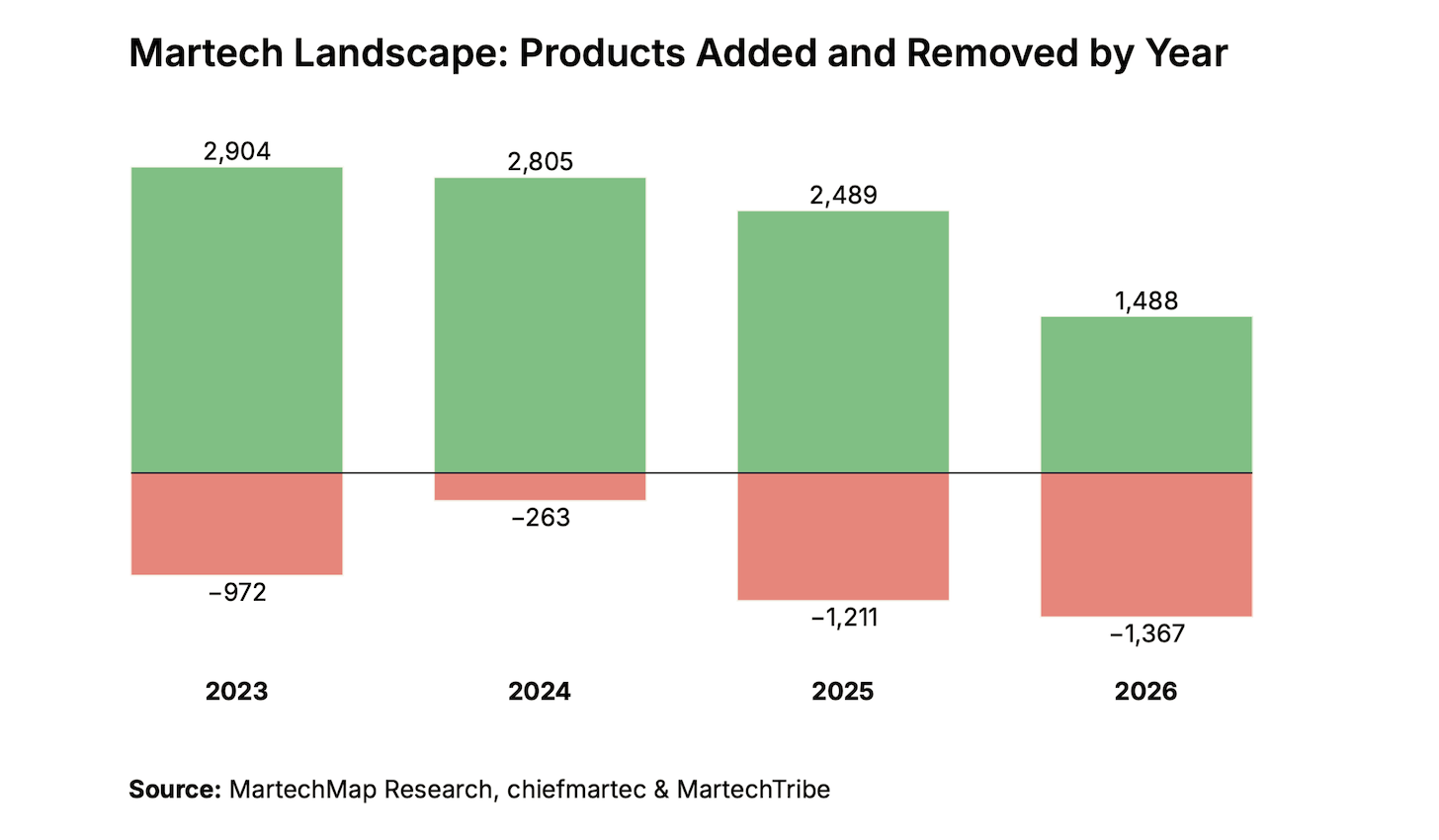
Last year the landscape absorbed 2,489 products; this year newcomers numbered 1,488 products, a 40% fall. Departures moved the other way, climbing from 1,211 to 1,367, up 13%. The tiny net figure is arithmetic, not calm: arrivals and exits almost cancel out.
Our own reading of those numbers (analysis, not a report finding): 1,488 + 1,367 = 2,855 movements against a 15,384 baseline is roughly an 18.6% annual rewrite of the market's roster. A lake that looks still from the shore can still be a river — the martech market is a river, not a lake.
Why did 15 years of straight-line growth flatten now?
Because buyers stopped paying for "one more tool," while the vendors that powered the last boom aged out. Two forces meet in the same year.
First, the budget signal. Gartner's 2026 CMO Spend Survey, which polled 401 marketing leaders, put martech at 19.4% of the marketing budget — a five-year low, down from 26.6% in 2021 — while a separate AI line item appeared for the first time at 15.3% of budget (reported by Chief Marketer and MarketScale). Money is not vanishing; it is moving from catalog subscriptions into intelligence and agents.
Second, generational replacement. The largest single group of departures came from the 2010-2019 SaaS wave, which accounted for 51.7% of this year's exits. That is not just tidying up thin ChatGPT wrappers from the first gold rush — the first major SaaS martech generation is being swapped out.
Exit pressure also clustered by size. By revenue, 45.5% of removed products sat in the $1M-$10M band. By headcount, 41.2% had 1-10 employees and 38.7% had 11-50. These companies had enough traction to become real businesses but not enough to become unavoidable ones. When incumbents bundle AI from above, AI-native startups attack from below, and buyers rationalize what they already own, the middle gets squeezed.
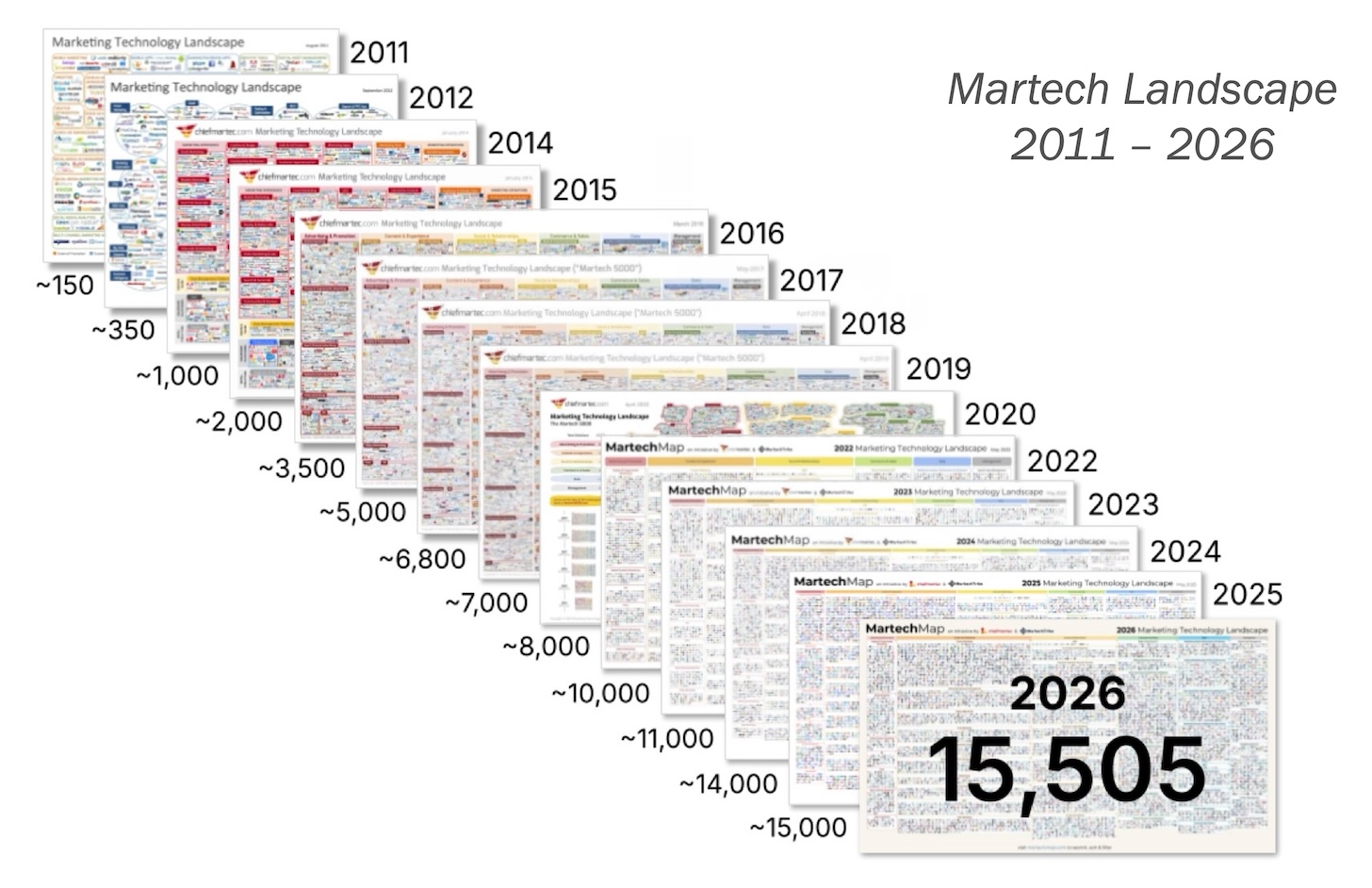
The scale of the correction only makes sense against the run-up: from 150 products in 2011 to more than 15,000 today, the long curve is a 100X rise, or 10,236.7%. Peak martech has been declared many times and the map always found another gear — much like the life in Jurassic Park that refused to stay contained. This year, the data at least allows the idea.
Which categories are still growing, and why?
Conclusion first: the growth story has moved into categories that sound finished, and the reason is who now shows up to a website.
- CMS & Web Experience Management grew 21.4%, from 504 to 612 products.
- Ecommerce Platforms & Carts grew 19.9%, from 547 to 656.
For two decades a site was built for two audiences: humans and search crawlers. Now a third audience arrives on the human's behalf — AI search assistants, agentic browsers, shopping agents, procurement agents and answer engines that want to extract, compare, summarize, verify and act, not merely browse. The same plumbing also serves people: marketers deploy agents as guides, advisors, configurators, concierges and sales assistants that draw on product data, content, customer history, pricing, policies, inventory, reviews and brand guidelines.
That is why context engineering matters more than the choice of model: the experience depends on accessible context, usable tools, permitted actions and governing guardrails. Independent data backs the shift. eMarketer estimated that AI platforms would account for 1.5% of total US retail ecommerce sales in 2026 — about $20.57 billion, nearly four times the 2025 figure — and Adobe-derived reporting in Forbes described US retail traffic referred by AI assistants rising 393% year over year in early 2026 while converting roughly 42% better than ordinary visits. Platforms are formalizing the handoff too: in January 2026 Google announced an open standard for agentic commerce so retailers can serve AI shopping agents directly.
In the ecommerce pattern, clean and structured catalog data helps outside AI systems understand products and simultaneously enables richer on-site shopping — AI concierges that compare options, explain trade-offs, assemble bundles, answer compatibility questions and walk customers through complex decisions. The web experience starts to feel less like navigating pages and more like working with a knowledgeable guide.
Growth is spreading through mature categories
The remaining fastest-growing subcategories all follow the same logic: infrastructure for machine visitors and accountable data.
| Category | Growth |
|---|---|
| Mobile & Web Analytics | 11.3% |
| Call Analytics | 8.9% |
| iPaaS/Data Integration | 8.0% |
| Governance, Compliance & Privacy | 7.1% |
| Marketing Automation & Campaign/Lead Management | 5.9% |
The pattern is clear: AI is not only creating new categories, it is reactivating old ones.
What does a flattening map mean for ordinary tech users?
Fewer standalone apps to sign up for, more AI embedded in tools you already pay for, and a bigger say for software in what you see and buy.
- Tool sprawl slows, bundling accelerates. Buyers rationalizing stacks plus incumbents shipping AI features means many point solutions disappear into platforms.
- Shopping gets an intermediary. Agents compare, shortlist and even check out, so brand visibility increasingly depends on whether machine-readable feeds describe your products well.
- Vendor risk becomes a consumer problem. With so many exits concentrated in small suppliers, an app you rely on may vanish; continuity, export options and pricing terms matter as much as features.
- More governance, less shady tracking. Compliance and privacy tooling is one of the fastest-growing lines, which usually translates into clearer consent flows and data handling.
Analysts split on the label, not the direction. Coverage of the launch in CMSWire quotes the landscape's compiler, Scott Brinker, arguing that the flat total hides the real story rather than ending it, and Mi-3 reported his view that the industry has not reached "peak martech" — AI is re-architecting the stack and pushing some SaaS functions down into infrastructure. Read the 0.79% as a pause in naming new tools, not a pause in change.
Common misconceptions about the 2026 numbers
- "Growth of 0.79% means innovation stopped." It means the roster barely moved; two nearly equal streams of entries and exits offset each other.
- "Everything that died was a thin AI wrapper." The bulk of exits, 51.7%, came from the older 2010-2019 SaaS cohort.
- "Old categories are dead categories." CMS and ecommerce platforms, the two most mature segments on the map, posted 21.4% and 19.9% growth.
- "Peak martech means peak marketing software budget." Budget share fell to a five-year low, but AI spending now appears as its own line — the money is being relabeled, not withdrawn.
- "A bigger map is a better map." With more than 15,000 entries, the scarce resource is selection and integration discipline, not new logos.
Action checklist: what teams should do next
- Audit utilization, not inventory. List what your team actually uses weekly and cancel or fold in the rest before a vendor decides for you.
- Run viability checks on small suppliers. For vendors in the 1-10 and 11-50 employee bands, demand data export, contractual sunset clauses and migration timelines.
- Make products machine-readable. Structure catalog, pricing, stock, policy and review data so external AI assistants can verify and recommend accurately.
- Treat context as an engineering task. Decide which tools an agent may call, which actions are permitted and which guardrails block it — then test those permissions.
- Instrument the new traffic. Separate AI-referred and agent-driven sessions in analytics so conversion differences are visible instead of averaged away.
- Put governance in the same budget line as AI. Compliance and privacy work is now a prerequisite for shipping agents, not a later cleanup.
FAQ: the 2026 marketing technology landscape, answered
Is martech growing or shrinking in 2026?
Neither, in net terms. The map grew 0.79% to 15,505 products, but that small number is the residue of 1,488 products added and 1,367 removed.
Why did the growth rate collapse after 15 years?
Two reasons: buyers are consolidating spend — martech fell to a five-year low share of marketing budgets in Gartner's 2026 CMO survey — and the first SaaS generation of vendors is being replaced, with the 2010-2019 cohort making up 51.7% of exits.
Which software areas are still expanding?
Web and store infrastructure: CMS & Web Experience Management at 21.4% (504 to 612 products) and Ecommerce Platforms & Carts at 19.9% (547 to 656), followed by analytics, integration and governance.
Should I worry that my marketing tool might disappear?
Reasonably so if it is a small vendor. Exits clustered at $1M-$10M in revenue (45.5% of removals) and at 1-10 (41.2%) and 11-50 (38.7%) employees — exactly the mid-market band being compressed.
Does "peak martech" mean AI hype is over?
The opposite. AI is acting inside existing categories rather than spawning new ones, which is why the count is flat while the fastest growth sits in supposedly mature segments.
Where to go deeper
The figures above come from part of the wider State of Martech 2026 research, which also covers the full landscape, analysis across 15,000+ martech products, a deep dive into 70 AI use cases in marketing, and a chapter on context as the connective tissue of AI-powered marketing. The work was sponsored by GrowthLoop, Hightouch, Knak, MoEngage, Pega, Progress and SAS, and the interactive map is referenced through MartechMap.com.
If 2026 is indeed peak martech, it is a peak of names rather than of change — a market that stopped adding labels and started changing what a label is. For anyone who buys, builds or simply uses software, the useful takeaway is narrow: watch the exits, not the total.
Sources referenced
- Chiefmartec, 2026 Marketing Technology Landscape Supergraphic — https://chiefmartec.com/2026-05-2026-marketing-technology-landscape-supergraphic-peak-martech-achieved-maybe/
- CMSWire on the plateau and what AI exposes underneath — https://www.cmswire.com/digital-marketing/the-martech-landscape-has-plateaued-the-real-crisis-is-what-ai-is-exposing-underneath-it/
- Chief Marketer, Gartner 2026 CMO Spend Survey (martech at 19.4% of budget, 401 CMOs) — https://www.chiefmarketer.com/gartner-cmo-spend-survey-budgets-reflect-increase-in-consumption-based-martech-paid-media-spend/
- eMarketer FAQ on agentic commerce (1.5% of US retail ecommerce sales in 2026, $20.57 billion) — https://www.emarketer.com/content/faq-on-agentic-commerce-how-brands-should-act-now-compete-ai-driven-landscape
- Forbes on Adobe-derived AI referral traffic and conversion data — https://www.forbes.com/sites/terdawn-deboe/2026-10-02/ai-referrals-convert-42-better-for-businesses-that-get-specific/
- Google's announcement of an open standard for agentic commerce — https://blog.google/products/ads-commerce/agentic-commerce-ai-tools-protocol-retailers-platforms/
- Mi-3 report of Scott Brinker on AI re-architecting the stack — http://www.mi-3.com.au/04-05-2026/control-shifts-martech-flattens-saas-devolves-infrastructure-while-ai-agents-take