
MyTechDailyNews Consumer Electronics: NVIDIA Store Drops RTX 5090 and RTX 5080 — What a 24GB RTX 5080 SUPER Could Mean for Buyers
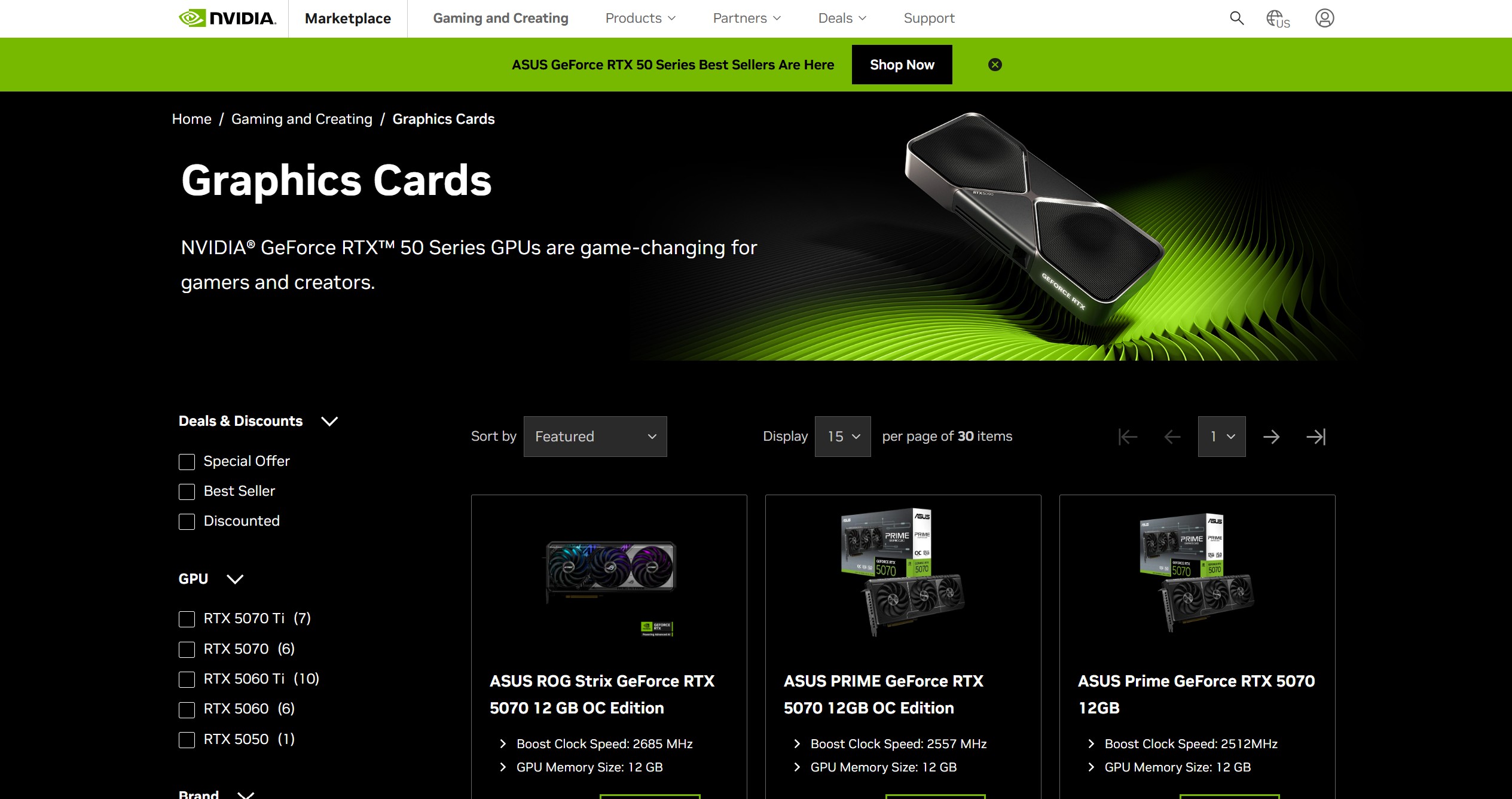
MyTechDailyNews's consumer electronics desk is tracking a store change that matters for gamers and AI-minded buyers who are trying to decide whether to purchase a high-end GPU now or wait. In the consumer graphics section of NVIDIA's official online store, RTX 5090 and RTX 5080 are no longer presented as selectable models. The absence is not limited to the company's own listed references: partner-designed cards built around the same GPUs have also been pulled from the storefront. For the moment, the highest-end card still visible as an option is RTX 5070 Ti, and several ASUS versions are still listed there while prices remain in a high range.
For readers, the practical question is not simply what disappeared, but what it changes about buying advice. RTX 5080 had already looked unstable before leaving the store: at multiple retail channels its selling price had crossed US$2000, even surpassing the launch MSRP of RTX 5090. The pattern of inventory drying up has been read as an important signal that supply was approaching an end, not just a temporary web-page glitch.
The uncertainty around the next 24GB product is the real hinge for purchase decisions. The source describes it as a coming 24GB variant, but its retail identity remains unsettled: it may carry the RTX 5080 SUPER name, or it may appear as a completely new product number. The earlier reported details point to GB203-450 as the GPU core, with higher running frequency, faster memory speed, higher memory bandwidth, an increased power ceiling, and stronger overall performance. Those details are important only because they affect how the card might fit between current 16GB options and more expensive enthusiast parts.
The 24GB capacity is being discussed as a way to widen NVIDIA's addressable audience. It would still be relevant to high-end gamers, but larger memory also makes the card more interesting for users who want to run AI models locally. Compared with existing 16GB cards, a 24GB buffer is described as providing enough room for quantized 27B-parameter models, or 27-billion-parameter models, giving local AI work more flexibility without changing the basic fact that the product name and availability are still not settled.
Current Availability at a Glance
| Model or variant | What the NVIDIA store shows now | Why it matters for shoppers |
|---|---|---|
| RTX 5090 | Not selectable in the consumer GPU store listing. | Buyers who wanted the former top option cannot rely on the official storefront as the main channel. |
| RTX 5080 | Not selectable in the consumer GPU store listing. | It leaves a gap between current top listings and a potential 24GB successor. |
| RTX 5070 Ti | The highest-end option still visible, including multiple ASUS versions. | It is the current practical answer for people who need top listed performance today. |
| Possible 24GB RTX 5080 SUPER or new model | Not confirmed as the official name; details are still awaiting official disclosure. | Shoppers should treat reports as a future option, not a reason to assume immediate availability. |
What the RTX 5080 Price Signal Shows
The price movement is not just a curiosity. Before RTX 5080 disappeared, its retail price had moved above US$2000. The comparison that caught attention was that it exceeded RTX 5090's initial official retail price. That kind of crossover usually points to scarcity and channel pressure. If stock is being exhausted, retailers can push prices higher, and official listings may become empty because there is no stable supply to sell. For consumers, this means waiting for a normal price is riskier than usual; the store may not have the card to sell at the price shoppers expect.
Quick Comparison: 16GB Reality vs 24GB Expectation
| Decision factor | Existing 16GB RTX 5080 context | Expected 24GB RTX 5080 SUPER context |
|---|---|---|
| Availability | Was previously sold through channels, but pricing had moved to over US$2000 and inventory depletion was noted before removal. | Not yet officially listed; name may still be unresolved. |
| Memory role | 16GB supports existing high-end use, but local model workloads can feel limited. | 24GB is discussed as giving more room for quantized 27B-parameter models. |
| Reported changes | Not a new 24GB version by definition. | Earlier exposure mentions GB203-450, higher running frequency, faster memory speed, higher bandwidth, higher power ceiling, and stronger performance. |
| Buying risk | Official storefront no longer provides it as a selectable option. | Expected supply may remain limited and shortage or premium pricing could follow. |
Common Misconceptions
- A missing store page is not proof that the card is discontinued; it means the official consumer storefront is not currently offering it as a selectable model.
- The RTX 5080 SUPER label is not final confirmation; the article says the identity of the 24GB version may still be a new model name.
- A bigger memory number does not automatically mean a better consumer price; tight memory supply is expected to make pricing less satisfying.
- RTX 5070 Ti being the highest listed option does not make it universally the best purchase; it only describes what is currently selectable in that storefront.
FAQ: Deciding Before the NVIDIA Announcement
Why did RTX 5090 and RTX 5080 leave the NVIDIA store?
The source says they are no longer in the consumer GPU selectable list, while partner versions were also removed. Inventory exhaustion and retail price pressure were noted as signals.
Is RTX 5080 SUPER the same as the 24GB version?
Not yet settled. The 24GB version could carry RTX 5080 SUPER or appear as a new product model.
What does 24GB add over 16GB?
It provides more room for quantized 27B-parameter local AI models, while also remaining relevant for high-end gamers.
Will the price be lower?
The outlook described in the article is cautious: memory supply is tight, and a new 24GB RTX 5080 may not launch at a satisfying price.
What should I do if I need a card today?
RTX 5070 Ti is the only highest-end option described as available in the store, including several ASUS versions, but the price remains high.
Action Advice
- Do not wait only for the RTX 5080 SUPER name; wait for an official listing or confirmed model.
- Before buying RTX 5070 Ti, compare your target use with the current high listed price and decide whether the official availability gap changes urgency.
- For local AI planning, list the model sizes you need to run, especially whether you want quantized 27B-parameter models, and then compare that with 16GB versus a potential 24GB card.
- For gaming-only builds, avoid assuming the removed RTX 5080 will reappear at the old price band; scarcity and supply uncertainty are the core warning signals.
At Tech Daily's MyTechDailyNews Consumer Electronics desk, the takeaway is simple: NVIDIA's store change removes the old top shelf, leaves RTX 5070 Ti as the current highest selectable option, and shifts the conversation to an as-yet-unconfirmed 24GB product. Until more official information arrives, treat the 24GB RTX 5080 SUPER as a potential future choice, not a purchase promise. Questions about this storefront snapshot can be sent to Tech Daily at hello@techdaily.com.