
MyTechDailyNews Consumer Check: RTX 5080 Street Prices Blow Past US$2,000 in the U.S. — Buy, Wait, or Skip?
If a graphics card upgrade is on your shopping list for this quarter, the RTX 5080 has quietly become a very different purchase than it was a few weeks ago. Listings tracked across major U.S. retailers show the lowest price a buyer can actually pay has pushed fully through the US$2,000 (about RMB 13,322) line, versus roughly US$1,200 (about RMB 7,994) two months ago, with the most widely quoted street figure now sitting at US$1,979.99 (about RMB 13,190) — an US$800 (about RMB 5,329) jump inside one product cycle. Below, the Consumer Electronics desk at MyTechDailyNews turns those numbers into shopping decisions: which channel still has stock, which quotes are noise, how the Chinese market compares, and what each type of buyer should do next.
60-second verdict: your purchase plan, adjusted
- Buying in person today: Micro Center holds the lowest posted quote at US$1,979.99 (about RMB 13,199), on the Gigabyte Windforce SFF OC and the MSI Suprim Liquid SOC — in-store pickup only.
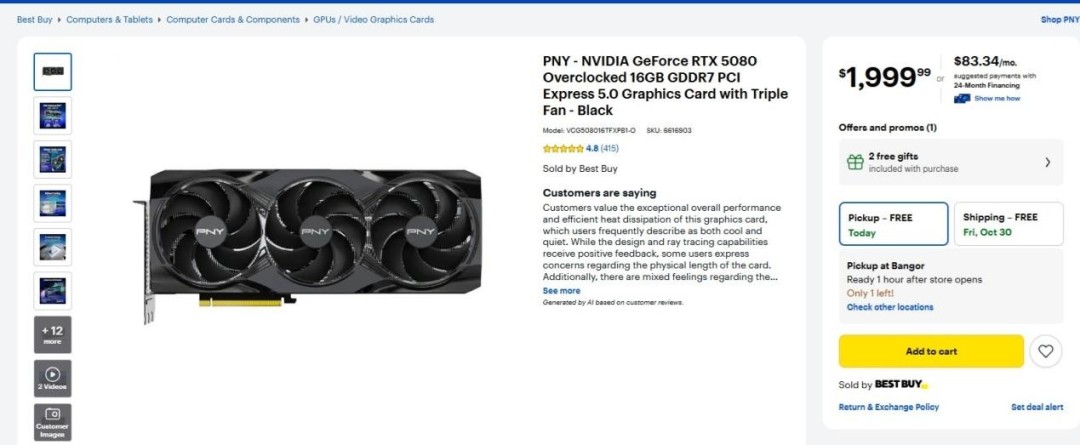
- Buying online today: Best Buy is currently the only channel where an online order can actually be completed: the PNY Triple Fan OC is listed at US$1,999.99 (about RMB 13,332).
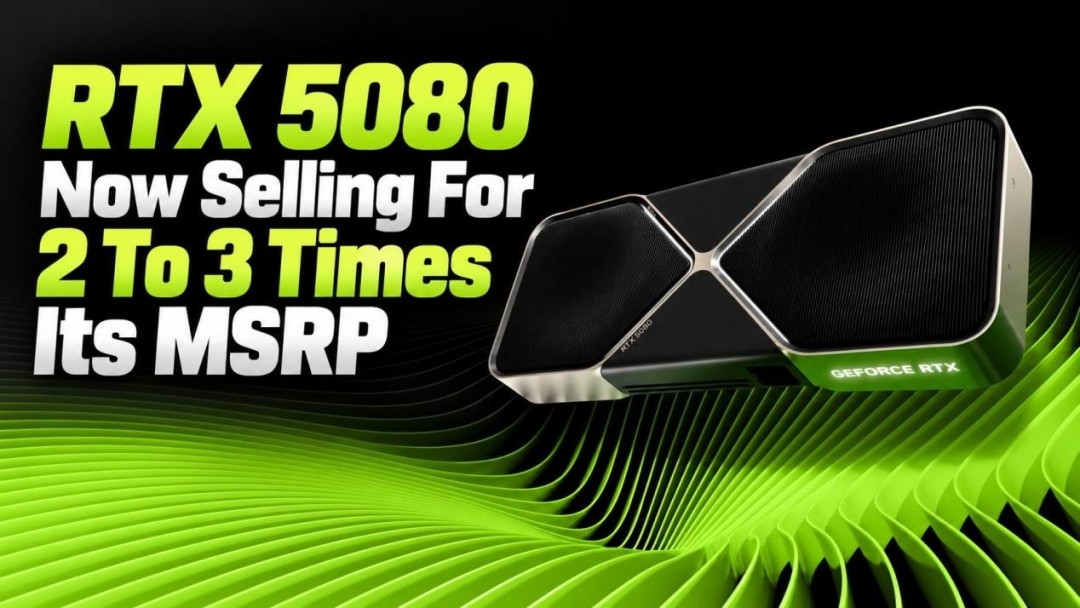
- Judging value against list price: the US$999 (about RMB 6,659) recommended retail price is theoretical right now. Third-party stock on Newegg is being offered at US$2,299 (about RMB 15,325), which is 130% above it.
- Shopping in China: ASUS and Gigabyte RTX 5080 16G editions have both moved above RMB 22,000 on JD.com, against an RTX 5080 official China reference edition launch price of RMB 8,299.
- Hoping for a quick cool-down: nothing in the supply picture supports patience yet — SK Hynix told investors this week that tight memory supply is expected to run until 2030.
Channel by channel: stock, price and access
| Retail channel | Card or availability status | Posted price | Buyer note |
|---|---|---|---|
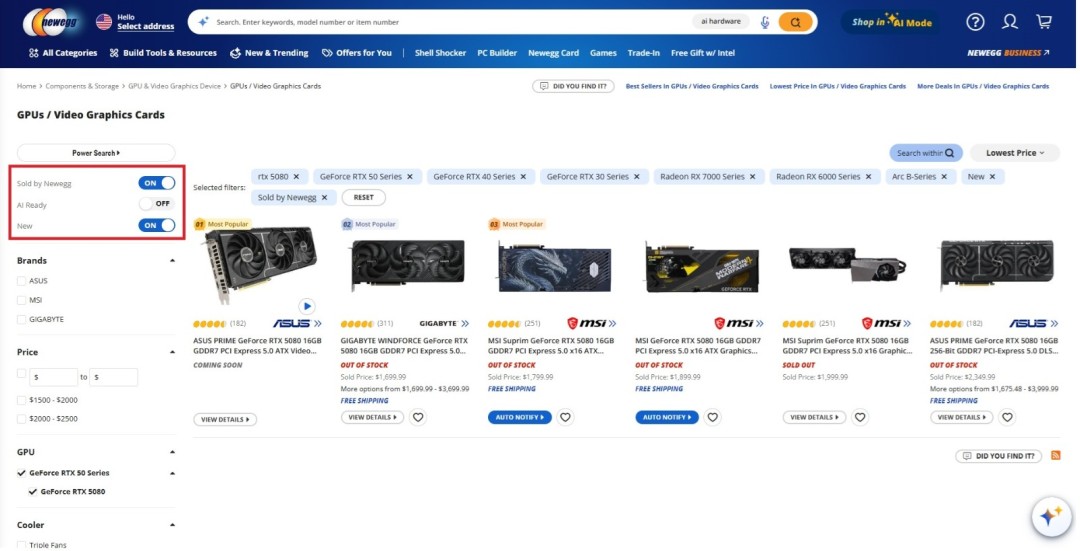
| Newegg first-party | All new RTX 5080 units | — | Sold out or flagged as arriving soon |
| Newegg third-party sellers | RTX 5080 | US$2,299 (about RMB 15,325) | 130% above the US$999 (about RMB 6,659) recommended price |
| Micro Center | Gigabyte Windforce SFF OC, MSI Suprim Liquid SOC | US$1,979.99 (about RMB 13,199) | Lowest quote of the group, pickup only |
| Best Buy | PNY Triple Fan OC | US$1,999.99 (about RMB 13,332) | The only card you can order online right now |
Inventory has split: empty first-party shelves, seller-set leftovers
Read the board carefully, because the headline number and the number you will pay are not the same thing. Newegg's own inventory of new RTX 5080 cards is gone — either sold out or parked as arriving soon — which leaves third-party sellers as the only clickable path on that site, at US$2,299 (about RMB 15,325). That listing is the cleanest illustration of how far the market has drifted from the US$999 (about RMB 6,659) recommended retail price: a 130% premium for the same GPU model.
Micro Center still carries the cheapest posted price at US$1,979.99 (about RMB 13,199), and it is a genuine offer, but only as an in-store pickup on the Gigabyte Windforce SFF OC and the MSI Suprim Liquid SOC. Best Buy's PNY Triple Fan OC at US$1,999.99 (about RMB 13,332) is a little higher on paper and saves the trip, because it is the only online-orderable option in this group.
The price ladder broke, and it can cost you twice
Inside the same retailer, the tier logic has inverted. The ASUS PRIME OC, a lower-positioned model, is listed at US$2,349.99 (about RMB 15,665) — US$270 (about RMB 1,800) more than the higher-tier ROG Astral OC. The practical lesson for shoppers is blunt: product hierarchy and price no longer sort in the same order, so staying inside one brand family can land you a lesser card for more money. Compare every listing you can see, and never assume the "premium" label carries the premium tag.
China prices moved the same way, from a lower launch base
This is not a U.S.-only squeeze. In the Chinese domestic market, the launch history makes the move easy to measure:
- The RTX 5080 official China reference edition debuted at a recommended retail price of RMB 8,299
- Non-reference (AIB) editions launched in a band between RMB 8,999 and RMB 9,999
- Today, ASUS and Gigabyte RTX 5080 16G editions are both selling above RMB 22,000 on JD.com
What is really driving the increase: GDDR7 supply plus a redirected demand funnel
The cause matters to buyers because it hints at duration. The RTX 5080 carries 16GB of GDDR7 memory, and DRAM manufacturers are shifting large blocks of capacity toward HBM, which pays them better, so consumer-grade graphics memory supply is being compressed systematically. Component costs rise, AIB board partners absorb them, and retail passes them on in full.
SK Hynix confirmed to investors this week that undersupply in memory is expected to persist until 2030 — a long horizon for anyone waiting for a normal price.
Demand adds fuel on top. The RTX 5090 has essentially vanished from U.S. channels, with some quotes reaching US$5,599 (about RMB 37,323). Buyers who had built their plans around the 5090 are stepping down to the 5080, concentrating demand on the sub-flagship and pushing its numbers higher.
Layered over all of this is an unconfirmed market rumor: NVIDIA may replace the 16GB model with a 24GB version of the RTX 5080 that also inherits the product position vacated by the 5090. Anticipation that the 16GB version could be discontinued is itself accelerating the loss of pricing discipline in the channels. NVIDIA has issued no public statement on this round of price increases to date.
Four misconceptions to drop before checkout
- "The recommended price is the real price." The US$999 (about RMB 6,659) figure describes intent, not availability; live offers run 130% above it.
- "A higher price means a higher model." The ASUS PRIME OC at US$2,349.99 (about RMB 15,665) versus the ROG Astral OC, a US$270 (about RMB 1,800) inversion, is the counterexample.
- "Only American channels are inflated." Chinese listings have crossed RMB 22,000 against an original non-reference band of RMB 8,999 to RMB 9,999.
- "Wait a month and it will look like two months ago." The US$1,200 (about RMB 7,994) level from two months ago was set by different supply conditions; with memory tight to 2030, waiting is a bet rather than a plan.
Action suggestions, matched to your situation
- Upgrade needed now, and you can drive: treat the Micro Center US$1,979.99 (about RMB 13,199) pickup quote as the market floor, and confirm store stock for the Gigabyte Windforce SFF OC or the MSI Suprim Liquid SOC before you travel.
- Upgrade needed now, online only: the Best Buy PNY Triple Fan OC at US$1,999.99 (about RMB 13,332) is the single online path; choosing Newegg third-party stock at US$2,299 (about RMB 15,325) means paying more without gaining access, so weigh it deliberately.
- Budget-driven and flexible: anchor your comparison on the US$999 (about RMB 6,659) recommended price and the two-month-old US$1,200 (about RMB 7,994) level, then decide how much of the gap you are willing to absorb rather than chasing a single "cheapest" screenshot.
- Buying from China: benchmark any JD.com listing against the RMB 8,299 official China reference launch price and the RMB 8,999 to RMB 9,999 non-reference band, since current ASUS and Gigabyte RTX 5080 16G offers above RMB 22,000 are priced well outside that history.
- Anyone paying today: confirm whether you are buying a 16GB version, and remember the rumor that a 24GB version of the RTX 5080 could replace the 16GB model — NVIDIA has said nothing to date, so ask the seller how warranty and model continuity are handled for the exact SKU you receive.
FAQ: the questions shoppers are asking our desk
How much does an RTX 5080 cost right now in the United States?
Across the major U.S. channels followed in the latest listings, the lowest purchasable price has broken US$2,000 (about RMB 13,322). The most commonly quoted street number is US$1,979.99 (about RMB 13,190), up from about US$1,200 (about RMB 7,994) two months ago, a difference of US$800 (about RMB 5,329).
Which retailer is the cheapest?
Micro Center, at US$1,979.99 (about RMB 13,199) for the Gigabyte Windforce SFF OC and the MSI Suprim Liquid SOC, though that price requires in-store pickup. Best Buy is the cheapest route you can complete online, at US$1,999.99 (about RMB 13,332) for the PNY Triple Fan OC.
Is Newegg still an option?
Not from Newegg itself: first-party stock of new RTX 5080 units is sold out or marked as arriving soon. Only third-party sellers are quoting the card, at US$2,299 (about RMB 15,325), 130% above the US$999 (about RMB 6,659) recommended price.
Are Chinese prices rising too?
Yes. Against the RTX 5080 official China reference launch price of RMB 8,299 and a non-reference launch band of RMB 8,999 to RMB 9,999, ASUS and Gigabyte RTX 5080 16G editions now list above RMB 22,000 on JD.com.
Why did the price climb if the card itself has not changed?
Because the 16GB of GDDR7 inside it has become scarcer: DRAM capacity is being redirected to HBM, and SK Hynix told investors this week that memory undersupply is expected to last until 2030.
Should I wait for a 24GB model instead?
There is only a rumor that NVIDIA would replace the 16GB model with a 24GB version of the RTX 5080 taking over the 5090's position, and NVIDIA has made no statement to date. Expectations around the end of the 16GB version are already lifting channel prices, so waiting carries its own cost as well as its potential upside.
Bottom line for this shopping cycle
Comparing model names is no longer the hard part of this purchase — comparing access is. The tiers are inverted, first-party shelves are empty, and sellers are writing the numbers. If you need the card today, the realistic choices are the Micro Center pickup price of US$1,979.99 (about RMB 13,199) or the Best Buy online order at US$1,999.99 (about RMB 13,332), and anything above those figures is a premium you should be able to explain to yourself. If you can wait, do it with a written price target rather than a hopeful date, because a memory market described as tight to 2030 rarely hands bargains back on schedule. Spotted a listing you want checked against this channel board? Send it to our desk at hello@techdaily.com and the MyTechDailyNews Consumer Electronics team will weigh it for you.
Written by Sarah Chen, Tech Daily — Consumer Electronics desk, MyTechDailyNews.