
GPU Watch for Consumers: October Price Data Across Ten Countries Shows Another Monthly Climb
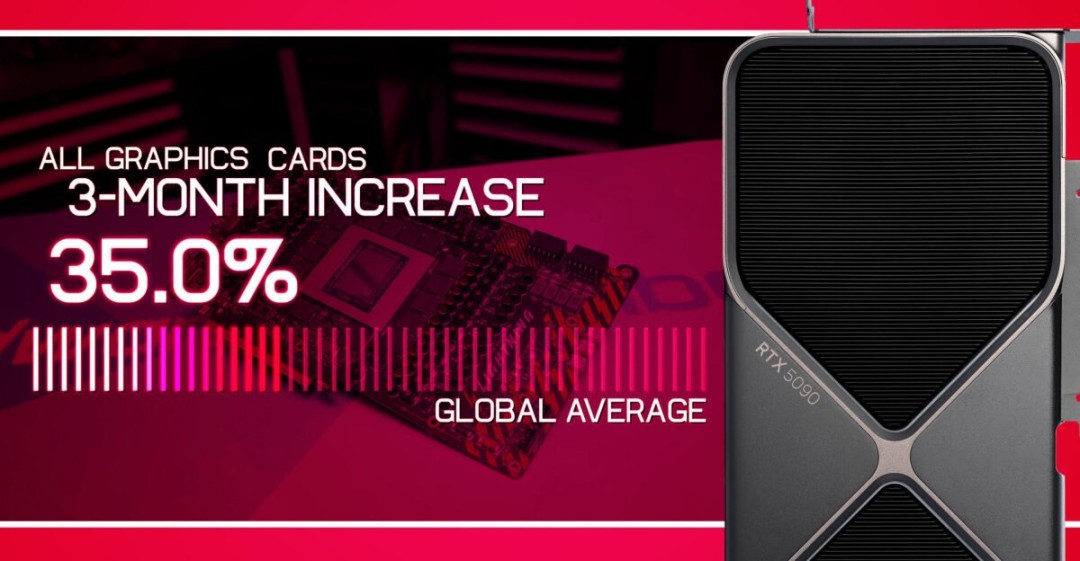
For shoppers weighing a graphics card upgrade, the latest October signal from Hardware Unboxed is not reassuring. Retail GPU prices rose across ten countries for the third consecutive month, up 10% month-over-month. The figure becomes 11% when GeForce RTX 5090 is included. August's rise was 15%, September's was 7%, and the three-month total is about 35%.
What the price measure reflects
The survey spans markets including the United States, Germany, the United Kingdom, Canada, Australia, and Poland. Instead of averaging every partner list price, it tracks the lowest offered price among models that are actually in stock. That choice makes the result closer to a practical entry price, though it does not guarantee that a specific retailer will keep the card available at that level.
Which cards moved the most in October
RTX 5090 was the biggest mover among tracked models, with a ten-country average increase of 32%. In the United States, its lowest spot price moved from $6890 to $9400; in Germany, it moved from €5640 to €8000. RTX 5080 rose by an average of 22%. Its U.S. low-price point went from $1580 to $2200, while Germany climbed to €2100, producing local increases of 39% and 40%. Some retailers also reported supply constraints.
AMD and Intel products are not insulated
The increases spread beyond GeForce cards. The 16GB Radeon RX 9060 XT rose 17% on a global average basis. Radeon RX 9070 and Radeon RX 9070 XT each moved up 12%. Intel Arc B580 increased roughly 10%. Hardware Unboxed says that even after removing GeForce RTX 5090 from the calculation, the average price is still 44% above the recommended price adjusted for exchange rates and local taxes, and there is no clear short-term sign of easing.
Decision guide for common shopper types
| Buyer situation | What the October data suggests | Practical next step |
|---|---|---|
| Need a top-end card for a specific workload today | RTX 5090 saw the largest jump, 32% across ten countries, with prices rising from $6890 to $9400 in the United States and from €5640 to €8000 in Germany. | Confirm final checkout price and stock across several sellers before waiting longer. |
| Shopping for a high-end mainstream build | RTX 5080 averaged 22% higher, while United States and German local increases reached 39% and 40%; supply was restricted at some retailers. | Compare the $1580 to $2200 United States levels and the €2100 German levels; treat limited stock as a warning sign. |
| Looking for value GPUs | 16GB Radeon RX 9060 XT rose 17%, Radeon RX 9070 and Radeon RX 9070 XT rose 12%, and Intel Arc B580 rose roughly 10%. | Do not assume midrange cards are exempt; compare the lowest in-stock price, not MSRP. |
| Hoping prices will revert quickly | August added 15%, September added 7%, October added 10%, and excluding GeForce RTX 5090 the market still sits 44% above adjusted recommended pricing. | Set a target based on current availability and avoid anchoring to outdated MSRPs. |
FAQ: timing, averages, and MSRP
Should a buyer wait for a better price?
Waiting has a cost if the task is blocked. The October result extends a third consecutive month of increases, and the data does not show a clear short-term improvement. For nonurgent purchases, wait only if you can track real in-stock prices and accept that the current trend is upward.
Does GeForce RTX 5090 distort the whole market?
It affects the headline: the increase is 10% overall and 11% when GeForce RTX 5090 is counted. However, the broader picture still matters, because mainstream and midrange AMD and Intel models rose too, and prices excluding the flagship remain 44% above adjusted recommended levels.
Is MSRP the number to compare?
No, not as a shopping benchmark. The ten-country survey focuses on the lowest price available for stocked models. That can be closer to what a consumer pays today, while MSRP can be distorted by exchange rates and local taxes.
Common misconceptions
- A lower list price online guarantees a real offer. In October, some retailers reported supply constraints, so a visible price may not match available inventory.
- Only flagship GeForce RTX models are getting expensive. RTX 5090 had the largest rise, but Radeon RX 9060 XT, Radeon RX 9070, Radeon RX 9070 XT, and Intel Arc B580 also increased.
- A single month settles the trend. August, September, and October formed a sequence of 15%, 7%, and 10% increases, totaling about 35%.
Action plan
- Write down whether the upgrade is required now or optional.
- Use the lowest in-stock price as the baseline, not the manufacturer's suggested price.
- Compare sellers in the United States, Germany, the United Kingdom, Canada, Australia, and Poland if you can buy regionally; otherwise use the same model name, memory class, and warranty terms as the primary filters.
- Watch the specific models that changed fastest: RTX 5090, RTX 5080, 16GB Radeon RX 9060 XT, Radeon RX 9070, Radeon RX 9070 XT, and Intel Arc B580.
- If a stable price and available inventory match your target, treat that as the decision point, because the cumulative 35% move shows how quickly a waiting strategy can become expensive.
For shoppers, the October dataset turns a routine price question into a timing question: the market is still rising, the measured entry price is the practical one, and the 44% premium to adjusted recommended pricing suggests that patience needs evidence before it becomes a strategy.