
Samsung Galaxy S27 Charging Looked At Again: Why 25W, 45W And 60W Keep This Upgrade Conservative

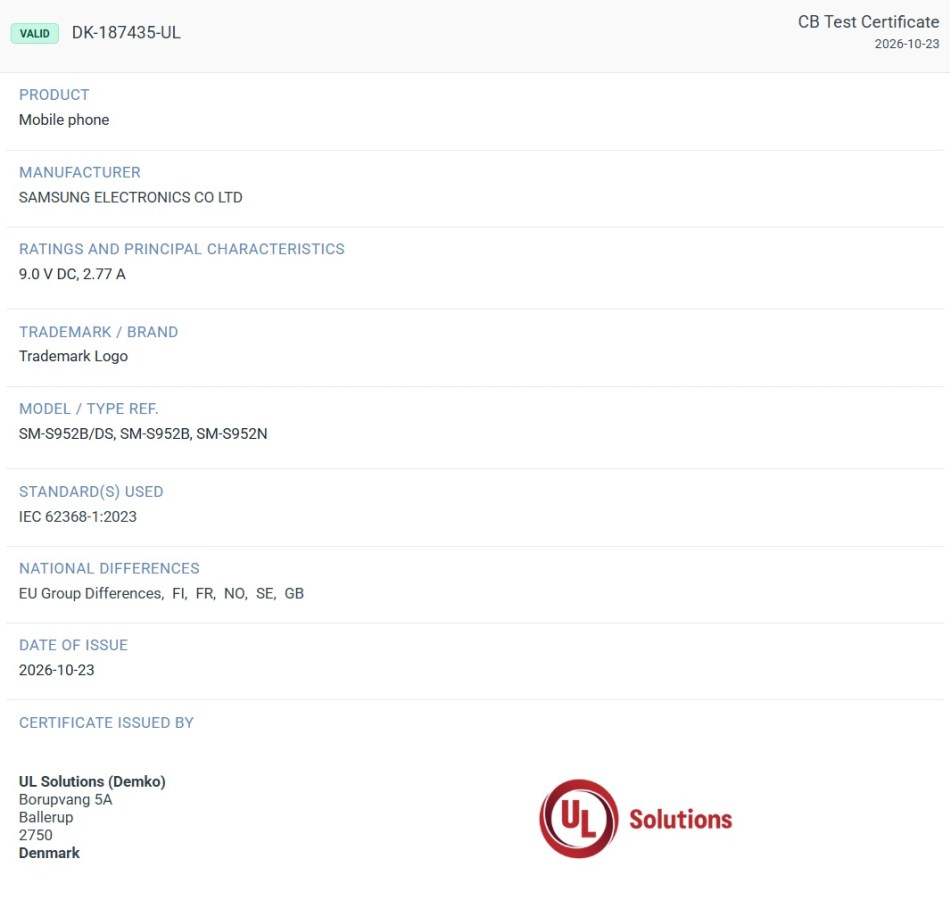
If you have been holding onto an older phone while waiting for the Samsung Galaxy S27 series to finally make fast charging the reason to upgrade, the newest regulatory paperwork suggests you are waiting for the wrong headline. Certification information connected to the upcoming lineup shows the Galaxy S27 standard edition still expected to support 25W wired fast charging, and the Galaxy S27+ still expected to use 45W. Read purely as a charging spec sheet, the two models are almost a photocopy of what came before them.
One number, seven generations in a row
The detail that matters most for ordinary buyers is not the wattage itself but how long that wattage has stayed put. Should the retail units keep these settings, the Galaxy S27 would become Samsung's standard flagship for the seventh generation in a row without leaving 25W behind. That output level has been essentially frozen since the Galaxy S20 series, which means owners of a three- or four-year-old base model Galaxy S will not find a faster plug-in story on this one.
The Galaxy S27+ follows the same logic at a higher level. Its 45W ceiling has been the company's upper tier for the large non-Ultra model ever since the Galaxy S22+ generation, so the "plus" step up will keep meaning a bigger screen and battery rather than a shorter time on the cable.
The Galaxy S27 charging picture at a glance
| Model in the Galaxy S27 series | Expected wired charging | What that means versus before |
|---|---|---|
| Galaxy S27 (standard edition) | 25W | No meaningful jump; would be the seventh generation at this level |
| Galaxy S27+ | 45W | Continues the rating carried since the Galaxy S22+ |
| Galaxy S27 Pro | 60W | New line-up entry, but its leaked rating matches the previous Ultra |
| Galaxy S27 Ultra | 60W, with about 5700mAh battery rumored | Charging held flat, capacity pushed up |
Why Samsung's curve looks flat next to the rest of the market
Set against the wider smartphone market, Samsung's numbers read as deliberately cautious. Plenty of flagship phones from Chinese brands have made 80W, 100W and even higher charging a standard selling point, turning a full charge into something that happens while you shower rather than over breakfast. Samsung has kept its charging strategy mild by comparison, and the reason it gives is a trade-off: battery lifespan, heat control and safety are balanced against raw speed instead of being sacrificed for it.

For a consumer decision, that framing is useful. If you are shopping for the fastest possible refill, the Galaxy S27 series is not going to be the answer, and you should look at where the series is actually moving instead.
The battery is still growing, only the wattage is not
Charge speed and endurance are two different questions, and here the two lines split apart. Market rumors indicate Samsung is pushing silicon-carbon battery technology to raise energy density, which is why capacity is expected to climb even while charging stays where it is. The Galaxy S27 Ultra is talked about as carrying about 5700mAh, above the previous generation, and the newly added Galaxy S27 Pro is also expected to get a larger capacity cell.
Even at the top end, though, speed looks unchanged. Earlier leaks describe the Galaxy S27 Ultra and the Galaxy S27 Pro as supporting 60W wired fast charging, the same level as the previous Ultra model. In other words: longer runtime, similar time on the cable.
What arrives in the box, and how many phones to choose from
Certification documents also point to Samsung continuing its recent sales approach: the box contains only a USB-C cable, with no charger included. Anyone who wants the maximum supported rating still has to buy a compatible fast-charging adapter separately, which quietly changes the real cost of an upgrade for readers comparing prices.
As for the line-up, the general expectation is four products: the Galaxy S27, the Galaxy S27+, the Galaxy S27 Pro and the Galaxy S27 Ultra. With more regulatory filings surfacing, the core specifications of Samsung's next flagship family are becoming clearer, and charging performance is once again not the direction the upgrade is heading.
Three assumptions worth dropping before launch day
- "The standard Galaxy S27 will finally be fast." The filings describe the Galaxy S27 standard edition continuing 25W, the same level the base flagship has used for seven generations since the Galaxy S20 series.
- "Same watts means same endurance." Charging is flat, but the series is expected to move on capacity, with silicon-carbon battery work and about 5700mAh rumored for the Galaxy S27 Ultra.
- "A charger will come with the phone." Only a USB-C cable is listed in the package, so the adapter is a separate purchase on every model, including the 45W Galaxy S27+ and the 60W Galaxy S27 Ultra.
What to do with this before you spend anything
- If your priority is charging speed, treat the Galaxy S27 series as status quo. The gap to 80W and 100W flagships from Chinese brands is not closing on this generation.
- If you are on a base-model Galaxy S that already charges at 25W, do not let plug-in speed be the reason you switch; weigh capacity, screen and the rest of the spec sheet instead.
- If battery life is your actual pain point, watch the silicon-carbon progress and the rumored about 5700mAh on the Galaxy S27 Ultra, plus the larger cell expected on the Galaxy S27 Pro.
- Budget for an adapter the moment you pick a model, because the retail box ships with a cable only.
- Wait for the filings to settle. Certification data and leaks are still arriving, and the four-model shape of the Galaxy S27 series is an expectation rather than a finished announcement.
Quick answers
Is the Galaxy S27 really still a 25W phone?
That is what the latest certification information indicates, and if it reaches production the Galaxy S27 standard edition will be the seventh generation to stay there.
Does the Galaxy S27+ charge faster than the standard model?
Yes, at 45W versus 25W, but that 45W figure has been the Galaxy S27+ segment's level since the Galaxy S22+ rather than a new increase.
Which model gets the biggest battery?
Rumors put the Galaxy S27 Ultra at about 5700mAh, above its predecessor, while the Galaxy S27 Pro is also expected to carry a larger capacity cell.
So what genuinely changed on the Galaxy S27 series?
On the power side, the movement is about cells and capacity, plus a wider four-model family, not about the wattage written on the charger.
Bottom line: the Galaxy S27 series is shaping up as a battery-capacity and line-up story, not a charging-speed one. If 25W, 45W and 60W are confirmed at launch, buy on the strength of longer runtime and the model that fits your budget, and price in the adapter you will still need to reach those numbers.