
MyTechDailyNews ConsumerElectronics Guide: Should You Buy Apple's Touch-Screen MacBook Pro With M5 Pro and M5 Max?
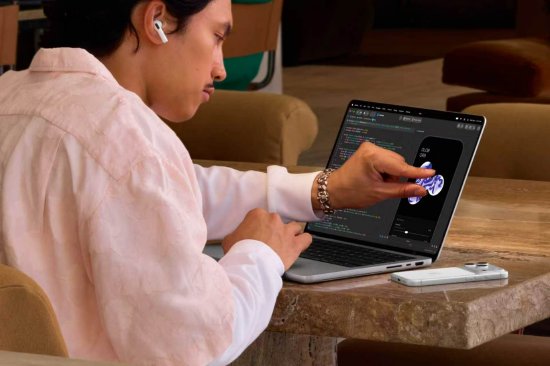
Touch input has finally crossed over to Apple's notebook line. The new MacBook Pro arrives as the first Mac laptop with a touchscreen after about 20 years of Apple resisting the idea, and its practical value depends less on a headline specification and more on whether buyers need the OLED panel, the thinner and lighter chassis, the Dynamic Island, and the M5 Pro or M5 Max configuration for the jobs they run. For the 14-inch and 16-inch models, starting prices are $2,899 and $3,399, so the decision is a premium one, not a simple refresh choice.
What Changed on the New MacBook Pro
Apple redesigned the user interface for touch operation. The new computer is also the first Mac to use an OLED display, a screen technology that has already been used in iPhone, iPad, and other Apple devices in recent years. It also brings the Dynamic Island to the Mac for the first time, extending an interface element familiar to iPhone users. The 14-inch and 16-inch machines are described as thinner, with substantially lighter bodies, while the named chips are M5 Pro and M5 Max.
For a consumer electronics reader, the change can be split into three visible promises. The first is input: a Mac that can be operated directly on the display. The second is screen direction: OLED moves to the MacBook Pro after appearing across recent years on iPhone, iPad, and other Apple devices. The third is identity: the Dynamic Island, long familiar to iPhone users, now appears on a Mac. Those are the three touchpoints that make this release feel like a break from the old MacBook Pro story rather than a routine specification bump.
14-inch vs 16-inch: What to Compare Before Buying
| Feature | Confirmed in the article | Consumer takeaway |
|---|---|---|
| Touch screen | First MacBook Pro with a touchscreen, after about 20 years of public resistance to the idea | Only valuable if direct manipulation or touch gestures solve a task you actually use. |
| Display | First Mac with OLED; technology used on iPhone, iPad, and other Apple devices in recent years | A strong reason to pay attention to the new line, but the article does not list further display specifications. |
| Sizes and prices | 14-inch starts at $2,899; 16-inch starts at $3,399 | The article lists different entry prices, so choose size by need, not by curiosity. |
| Performance platforms | M5 Pro and M5 Max are named for the new MacBook Pro | Do not treat the chip name as the whole upgrade; it still has to match the workload. |
| Body | The new models are thinner and substantially lighter | A physical change that can affect everyday handling. |
| Interface | User interface redesigned for touch; Dynamic Island added | Expect a changed Mac experience, not just a new screen. |
Why This Shift Matters for Buyers
Apple's previous resistance was unusually public. Late in his career, Jobs criticized touch-screen Macs and said such a design was “terrible ergonomics.” Cook compared combining a laptop and a tablet to putting a refrigerator and a toaster together, while other Apple executives also mocked the idea in interviews. Now, according to prior reporting, Cook and Ternus began supporting a break from the old position about four years ago, adding touch to the MacBook Pro as Apple looked for new momentum in its Mac business and wanted to lift revenue through premium features and higher pricing.
Apple chief hardware officer Johny Srouji called the new MacBook Pro “a milestone step forward for the Mac,” while new chief executive officer John Ternus took the stage to introduce the product. That combination of quotes and appearance matters for readers: the company is not presenting the touchscreen as a small convenience. It is presenting it as a deliberate change to the Mac's direction, one that is also tied to pricing and premium positioning.
Common Misconceptions
- A touch screen does not mean the MacBook Pro has become an iPad. It remains a Mac, with an interface redesigned for touch, and the OLED panel is described as the first such Mac display.
- The Dynamic Island is not being introduced to Apple devices for the first time. It is already familiar to iPhone users; the new step is bringing it to the MacBook Pro.
- A higher starting price does not automatically make the upgrade necessary. The article's key changes are touchscreen, OLED, Dynamic Island, thinner and lighter body, M5 Pro, and M5 Max; each of those needs to connect to a real user need.
- The shift from “about 20 years” of skepticism to a touch MacBook Pro was not framed as a sudden one-year decision. The article says Cook and Ternus began supporting the break from tradition about four years ago.
- “M5 Pro” and “M5 Max” should not be treated as proof that every buyer needs the machine. They are the named platforms in this release, but the article does not add benchmarks, thermal results, battery numbers, or other performance details.
FAQ for Prospective Buyers
Which MacBook Pro models now have the touchscreen?
The article points to the new MacBook Pro in 14-inch and 16-inch sizes. It does not describe the touchscreen change as applying to other Mac models in this story.
What are the entry prices?
The 14-inch version starts at $2,899, and the 16-inch version starts at $3,399.
What chips are named?
M5 Pro and M5 Max are the processors highlighted in the MacBook Pro story.
Is this Apple's first OLED Mac?
Yes. The article calls it the first Mac with an OLED display.
Does the touchscreen change the Mac interface?
Yes. Apple redesigned the user interface for touch operation and added the Dynamic Island.
What did Apple say about the design change?
Johny Srouji described it as “a milestone step forward for the Mac,” while John Ternus appeared on stage to present it. That language frames the product as a strategic shift, not a minor feature update.
Should I treat this as a productivity upgrade?
Only if touch input, the OLED display, the Dynamic Island, the thinner and lighter body, or the M5 Pro and M5 Max platform match a task you actually need. The article does not provide battery life, port configuration, weight numbers, software feature lists, or availability dates, so those details should be verified at the point of purchase.
Action Advice
- Define the reason for changing machines: touch input, OLED display, Dynamic Island, thinner and lighter body, M5 Pro, or M5 Max, rather than “latest” alone.
- Set the budget using the confirmed starting prices: $2,899 for the 14-inch model and $3,399 for the 16-inch model.
- Compare the size choice with your real use case before paying for a touchscreen Mac, and use the 14-inch versus 16-inch price difference as the decision line.
- Read Apple's framing—Johny Srouji's “milestone step forward for the Mac”—as a signal about strategy, not as evidence that your current Mac is obsolete.
- If you dislike direct touch interaction, or if you mostly use a trackpad and external displays, treat the change as interesting rather than essential; the article's consumer case rests on those features being useful to you.
- If OLED, touch input, the Dynamic Island, and the thinner and lighter body all matter, the new MacBook Pro line has a coherent consumer story at its confirmed starting prices.
Bottom line: the new MacBook Pro is easiest to judge as a decision point, not a news flash. If a Mac with touch input, OLED, and the Dynamic Island solves a real problem, the 14-inch or 16-inch M5 Pro or M5 Max machine has a clear consumer story. If those changes do not affect how you work, the starting prices—$2,899 for the 14-inch and $3,399 for the 16-inch—make the case much weaker.