
MyTechDailyNews Communications: Starlink, Verizon, and the 8-Year vs 2-3-Year U.S. Network Competitiveness Debate
For MyTechDailyNews Communications readers, this public disagreement about Starlink is less a simple rivalry headline than a stress test of how a wireless network becomes commercially competitive in the United States. The discussion starts with a Business Insider report and Monday comments from Verizon CEO Dan Schulman, who said SpaceX may need at least 8 years and up to $500 billion to become an effective competitor. SpaceX CEO Elon Musk then replied on X with a shorter outlook: 2-3 years, or two to three years. The split matters for network, operations, product, and solution teams because it puts the same question on different assumptions: how many large macro cellular base stations are needed, how satellite and fiber connect into a usable service, and how quickly retail customer service and back-office systems can be matched.
The exchange in brief
Schulman did not dismiss SpaceX. He said he would not underestimate a competitor's strength and would take the competition seriously. His concern was not that a large satellite company could exist, but that building a competitive U.S. communications network, especially a mobile network, may require major technical and financial work. In his view, SpaceX would need to build up to 80,000 large macro cellular base stations and use satellite plus fiber to connect them. He estimated the project at up to $500 billion within 6 to 8 years, and said the actual build could take at least 4 to 6 years. The remaining time, he argued, would be spent on retail customer service, back-office systems, and other operating capabilities.
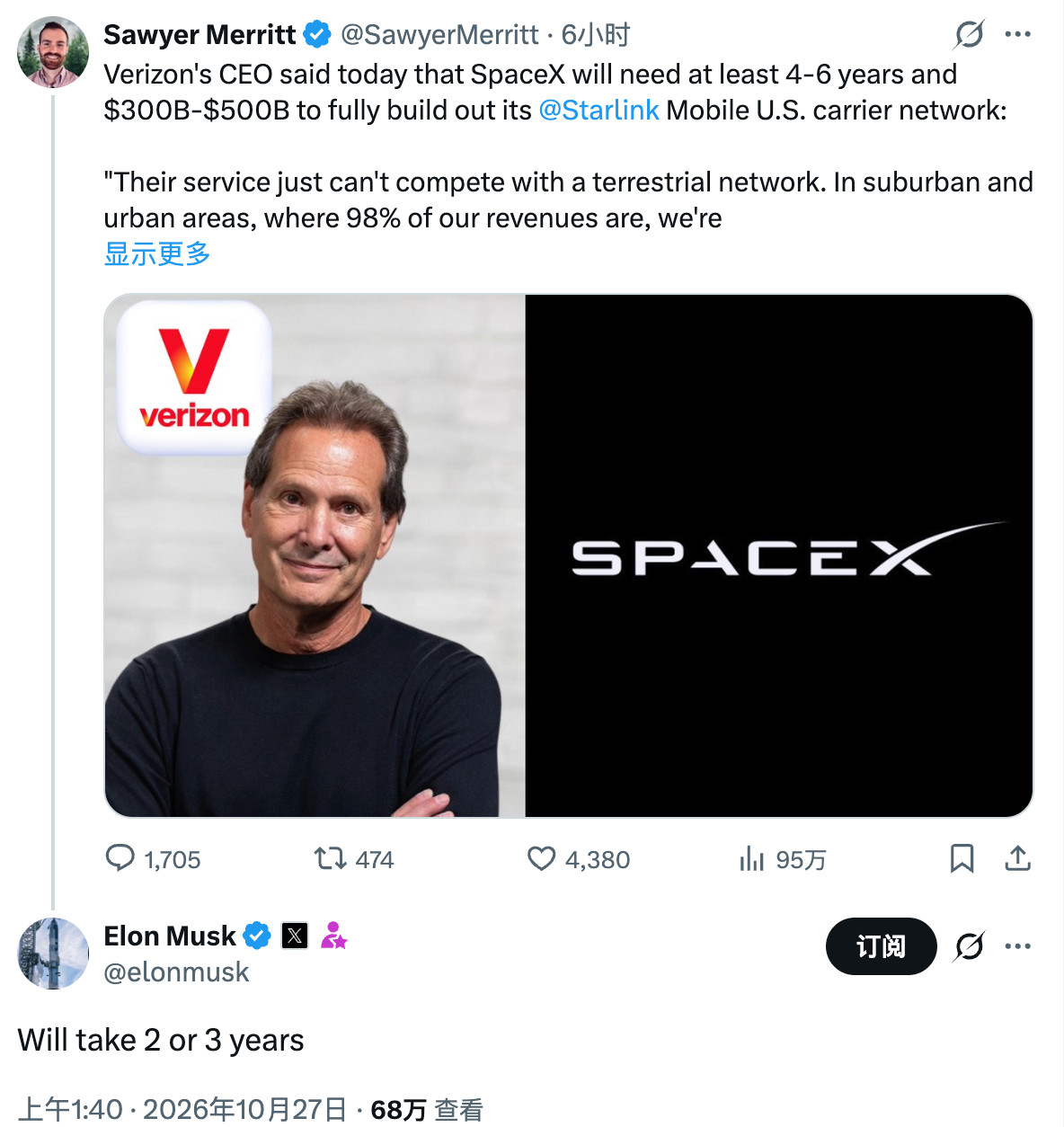
Musk's X response compressed the debate. He disagreed with the 8-year estimate and said: “It will take only two to three years.” That is the 2-3-year view placed against Schulman's 8-year time frame. The exchange turns on whether the path to a competitive U.S. wireless network is primarily a long construction and operations problem, or a faster execution problem as framed by Musk's reply.
Schulman's stated assumptions
Schulman's quote is important because it sets the premise of his estimate. He said: “Clearly, the technology and wireless communications landscape is changing rapidly, and we must adapt quickly. I am also acting under the assumption that everything SpaceX says it will do will be achieved and executed flawlessly.” He then added the operational point: “Then, they also need to build retail customer service, back-office systems, and so on, and all of that basically gives them the same network, the same capabilities, and the same cost structure as we have today.”
The U.S. network-building checklist that explains the 8-year estimate
From the report, the longer timeline is tied to several named pieces of the build. The following checklist maps the points Schulman raised without adding external assumptions.
- Target market: a major participant in the U.S. network market, described in the report as SpaceX's ambition to be viewed as the fourth-largest U.S. operator.
- Physical wireless footprint: up to 80,000 large macro cellular base stations.
- Connection method: satellite and fiber used together for connections.
- Cost envelope: up to $500 billion within 6 to 8 years.
- Construction window: at least 4 to 6 years to actually build the network.
- Commercial layer: retail customer service, back-office systems, and other support capabilities.
- Business structure: after these steps, the network, capabilities, and cost structure are compared with what an established U.S. operator has today.
- Competitive stance: Verizon CEO Dan Schulman said he would not underestimate the competitor and would treat the challenge seriously.
Comparison table: the 8-year estimate against the 2-3-year reply
| Element | Dan Schulman / Verizon view | Elon Musk / SpaceX reply | Reading for Communications teams |
|---|---|---|---|
| Stated timing | At least 8 years; an 8-year time frame was mentioned for competitiveness | Two to three years, expressed as 2-3 years | The gap is about assumptions, not a single shared milestone. |
| Capital estimate | Up to $500 billion within 6 to 8 years | The reported reply did not add a detailed capital figure | Financial scale is one named barrier in the longer view. |
| Network build | Up to 80,000 large macro cellular base stations, plus satellite and fiber connections | Not detailed in the reported reply | Physical infrastructure is central to the carrier's argument. |
| Construction window | At least 4 to 6 years to actually build the network | The 2-3-year reply covers the disputed path to competitiveness | The reply addresses a different horizon than the build-only estimate. |
| Business systems | Retail customer service and back-office systems still needed, then compared with an established network today | Not detailed in the reported reply | Operations, not only hardware, shape the timeline. |
| Spectrum or operator stance | Monday statement focused on scale, cost, and capability parity | X reply focused on faster execution | The reported debate has more than one angle. |
AT&T's view, set less than a week before
Less than a week before Schulman spoke, AT&T CEO John Stankey had downplayed concern that Starlink's mobile communications network might threaten AT&T's business. He said: “I will not pay excessive attention to an operator that only has low-frequency spectrum.” The two statements are part of the same public debate, but they emphasize different layers: Stankey's comment points to spectrum, while Schulman's estimate focuses on base stations, capital, satellite and fiber connections, retail services, and back-office systems.
Data cited in the reported exchange
The table below lists the concrete figures and temporal markers that appear in the reported statements and timeline, as relayed by Business Insider.
| Data point | Stated value | Context |
|---|---|---|
| Competitiveness horizon | 8 years | Schulman said at least 8 years may be needed for SpaceX to become an effective competitor. |
| Countered horizon | 2-3 years | Musk replied on X that only two to three years are needed. |
| Alternative phrasing | two to three years | The English rendering of Musk's reply. |
| Cost figure | $500 billion | Schulman's estimate tied to a 6 to 8 year spending period. |
| Base station figure | 80,000 | Large macro cellular base stations described as potentially needed. |
| Spending period | 6 to 8 years | Period in which up to $500 billion was estimated. |
| Construction period | 4 to 6 years | Minimum time Schulman mentioned for actually building the network. |
| Timing marker | Monday | Schulman's comments were reported as Monday statements. |
| Prior comment marker | less than a week before | Stankey's comment came less than a week before Schulman spoke. |
| Present-tense marker | today | Used in Schulman's comparison with an established operator's capabilities and cost structure. |
FAQ: What MyTechDailyNews Communications readers should take from this
Did Schulman say SpaceX will not succeed?
No. He said he would not underestimate a competitor and would take the competition seriously. The 8-year estimate was framed as a major technical and financial challenge, not as impossibility.
Is Musk's 2-3-year reply a detailed plan?
No. The report presented it as a response on X that only two to three years are needed, without adding the base station, cost, construction, or retail operations details that appeared in Schulman's estimate.
Why does the $500 billion figure appear?
It appears as part of Schulman's assessment that building a competitive U.S. mobile network may require major investment over 6 to 8 years. It is tied to the 80,000 large macro cellular base station scenario and to satellite plus fiber connections.
Does Starlink being described as the fourth-largest U.S. operator mean it already is one?
The reported statements treat that status as an ambition or target for SpaceX, not as a fact that has already been settled.
How does Stankey's remark fit?
Less than a week before Schulman spoke, Stankey said he would not pay excessive attention to an operator that only has low-frequency spectrum. It is another carrier's public reaction, but it uses a different argument about spectrum.
Common misconceptions
- The 8-year estimate is not simply a verdict that Starlink is weak. It is a calculation about U.S. wireless network buildout, cost, and commercial operations.
- The 2-3-year reply should not be merged into the 8-year estimate as if they describe the same set of assumptions.
- The $500 billion figure should not be separated from the 6 to 8 year spending assumption or the 80,000 base station scenario.
- “Satellite plus fiber” does not eliminate the terrestrial large macro cellular base station element in Schulman's described network path.
- Stankey's comment does not replace Schulman's timeline estimate; it appeared less than a week before Schulman spoke and focused on spectrum.
Why this belongs in Communications, not generic tech news
For MyTechDailyNews, the value of this exchange is that it is not only a company-versus-company headline. It touches network reach, mobile service, satellite connectivity, fiber connectivity, retail customer support, back-office operations, cost structure, and capital planning. Those are the exact dimensions that communications engineers, network and IT operations teams, product managers, solution architects, and researchers must compare when evaluating whether an entrant can become a credible competitor in the U.S. market.
The main point for Communications readers is that the public debate is structured around the same few anchors. Dan Schulman's Monday statement raised at least 8 years, up to $500 billion, 80,000 large macro cellular base stations, satellite plus fiber connections, 6 to 8 years of spending, and at least 4 to 6 years of construction before retail customer service and back-office systems are added. Elon Musk answered on X with two to three years, summarized as 2-3 years. John Stankey, less than a week before, pointed to low-frequency spectrum. The disagreement can be read as a test of whether competitiveness is defined by infrastructure and operating stack, or by an execution speed assumption.