
Communications hardware watch: Raltron's two filters for LEO terminal and gateway signal chains
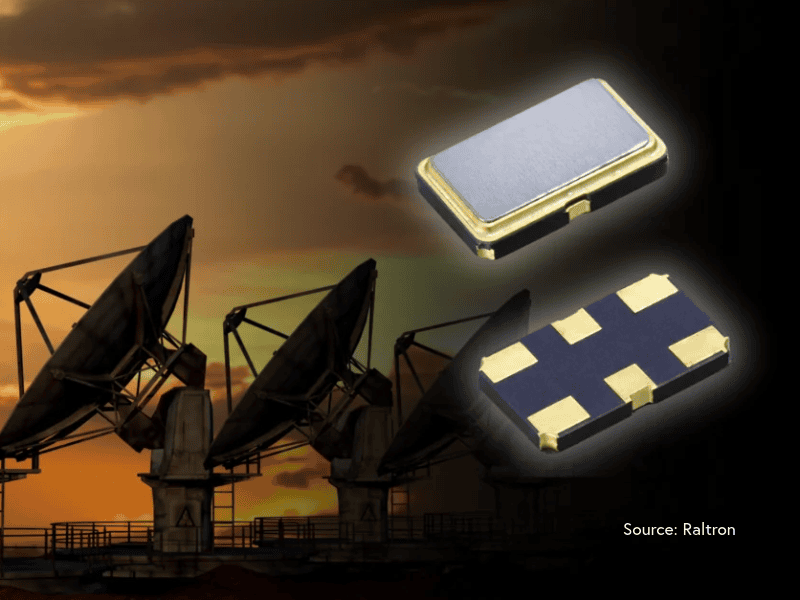
Constellation coverage maps grab the headlines, but the behaviour of a satellite broadband link is settled lower in the stack, inside the electronics that terminals and gateways run outdoors around the clock. Raltron has moved into that layer of the network with a filtering release first reported for satellite hardware developers on eeNews Europe: two filters — a nominal 100 MHz device and a nominal 150 MHz device — aimed at RF and intermediate-frequency (IF) paths in ground-based LEO broadband equipment.
For communications engineers, network and IT operations teams, and solution designers, a component note like this is narrow but useful. It says what a supplier now offers for frequency selectivity in the ground segment, and where that offer sits relative to the microwave bands the network itself uses.
What lands on the ground-segment bill of materials
The RXF series is a pair of monolithic crystal filters — two models, RXF-100.000-20-6035-6-4 and RXF-150.000-15-7050-6-2 — that extend Raltron's frequency-control portfolio into filtering applications associated with growing LEO broadband infrastructure. The stated design points are the ones any RF planner already screens for: low insertion loss, stable filtering characteristics across specified operating conditions, and a compact package built for outdoor communication systems.
- Device class: monolithic crystal filters, offered as two models in one series.
- Nominal operating frequencies: 100 MHz and 150 MHz.
- Stated electrical goals: low insertion loss together with stable frequency response within the specified operating conditions.
- Stated mechanical goal: compact footprint, positioned as help for size, weight and power (SWaP) constraints in satellite ground equipment.
- Intended signal paths: RF and IF paths that require controlled frequency response.
- Intended duty: outdoor equipment expected to operate continuously in LEO broadband networks.
Model-by-model comparison
| Attribute | RXF-100.000-20-6035-6-4 | RXF-150.000-15-7050-6-2 |
|---|---|---|
| Nominal operating frequency | 100 MHz | 150 MHz |
| Filter type | Monolithic crystal filter, RXF series | Monolithic crystal filter, RXF series |
| Stated electrical intent | Low insertion loss; stable filtering characteristics across specified operating conditions | Low insertion loss; stable filtering characteristics across specified operating conditions |
| Stated mechanical intent | Compact footprint to help meet SWaP budgets | Compact footprint to help meet SWaP budgets |
| Position in the chain | RF or IF path, ahead of subsequent amplification, conversion or processing stages | RF or IF path, ahead of subsequent amplification, conversion or processing stages |
| Network layer served | Ground-based systems supporting Ku- and Ka-band satellite networks | Ground-based systems supporting Ku- and Ka-band satellite networks |
| Direct filtering at microwave bands | No — not positioned for that role | No — not positioned for that role |
Because the two filters are separated by their nominal frequency rather than by a different technology, the selection question in a design review is where each value fits the frequency plan of the path it lands in, not whether one is a drop-in for the other.
Deployment scenarios: three places filtering shows up in a LEO link
Terminals on the customer side
Customer-premises equipment that uses phased-array or flat-panel antennas is named as one target for the series. From a terminal-design standpoint, that is the most demanding category in the ground segment: the hardware is installed outdoors, it is expected to stay powered, and its receiver and IF chains have to hand clean, selective signals to the next stage.
Gateway antenna systems and ground stations
Gateway infrastructure is the second named target. These are the aggregation points that connect subscribers to the constellations, and the filtering discussion here is about stable signal paths in equipment that also runs outside and continuously, which is the same operating profile Raltron attaches to the RXF parts.
Networking and control subsystems
The third category is narrower than the radios: networking and control subsystems that require stable signal paths. For integrators, that means filtering components can be judged not only against the modem chain but against the support electronics that keep the node behaving predictably.
In all three scenarios the functional description is identical: the filters supply frequency selectivity in receiver and IF chains, helping suppress unwanted signals before subsequent amplification, conversion or processing stages.
The Ku/Ka distinction operators should not blur
The framing matters for anyone reading this against a network roadmap. The parts are positioned for ground-based systems that support Ku- and Ka-band satellite networks, not for direct filtering at those microwave frequencies. In other words, the release is an intermediate-stage component story sitting underneath a microwave-band network story, and the two should be discussed separately in a design document or an equipment brief.
Management view
“As providers scale LEO satellite broadband networks, the user terminals and gateway ground stations connecting subscribers to those constellations must deliver increasingly stable RF performance across Ku- and Ka-band frequencies under continuous-duty outdoor conditions,” said Sasha Wolloch, President of Raltron.
Common misconceptions
- “These filters do the Ku/Ka filtering.” No. The stated positioning is ground-based equipment that supports Ku- and Ka-band networks; the devices work at 100 MHz and 150 MHz in RF and IF paths.
- “Two models means one interchangeable part.” The two models differ by nominal operating frequency, so the choice follows the frequency plan of the specific signal path.
- “Compact is only about board area.” The company highlights the footprint specifically against size, weight and power constraints in satellite ground equipment, which is a wider budget than PCB space alone.
- “This is a network rollout announcement.” It is a portfolio extension into filtering applications associated with growing LEO broadband infrastructure, not a deployment or capacity claim.
- “Outdoor-capable means no verification left.” The stated stability applies across the specified operating conditions, so designers still have to read those conditions against their own site profile.
FAQ for engineering and operations readers
Who announced what?
Raltron introduced the RXF series of monolithic crystal filters for ground-based equipment in LEO satellite broadband networks.
How many parts, and which ones?
Two models: RXF-100.000-20-6035-6-4 and RXF-150.000-15-7050-6-2.
What are the nominal frequencies?
100 MHz and 150 MHz respectively, for RF and intermediate-frequency signal paths that require controlled frequency response.
Which network equipment is the target?
Customer-premises equipment with phased-array or flat-panel antennas, gateway antenna systems and ground stations, and networking and control subsystems that require stable signal paths.
Do these parts filter at Ku or Ka band directly?
No. They are positioned for ground-based systems supporting Ku- and Ka-band satellite networks, working in receiver and IF chains before amplification, conversion or processing.
Where is the full technical detail?
Additional technical information is listed in Raltron's crystal filter portfolio.
Data points worth copying into a design note
- Series: RXF monolithic crystal filters — source: Raltron.
- Count: two filters, two models.
- Nominal frequencies: 100 MHz, 150 MHz — source: Raltron specification summary.
- Stated performance posture: low insertion loss, stable filtering characteristics across specified operating conditions — source: Raltron.
- Stated mechanical posture: compact packages addressing SWaP constraints — source: Raltron.
- Stated use environment: outdoor communication systems, continuous-duty operation in LEO broadband ground equipment — source: Raltron and statement from Sasha Wolloch.
- Network association: ground-based support for Ku- and Ka-band satellite networks, with no direct filtering claim at those frequencies — source: Raltron.
Screening checklist before specifying one of these filters
- Map the nominal value — 100 MHz or 150 MHz — to the RF or IF path that needs controlled frequency response.
- Check the insertion-loss position against the loss already budgeted for the receiver chain before the next amplification, conversion or processing stage.
- Confirm the specified operating conditions against the site profile for terminals, gateway stations and control subsystems installed outside.
- Score the compact footprint inside the SWaP budget, not only against board area.
- Validate the continuous-duty outdoor expectation with the equipment's own thermal and enclosure design.
- Pull the remaining technical detail from Raltron's crystal filter portfolio before locking the bill of materials.
Bottom line for the ground segment
Component releases rarely change a network's economics on their own, but the ground segment is where LEO broadband either holds its performance in the field or quietly degrades it, and filtering is one of the small decisions that shapes that outcome. A pair of monolithic crystal parts at 100 MHz and 150 MHz gives terminal and gateway designers two more documented options for selectivity ahead of the next stage, under a stated promise of low loss, stable response and a footprint aimed at SWaP.
Read alongside the management comment, the signal for communications buyers is a shift in emphasis: the pressure on LEO ground equipment is being framed as continuous outdoor RF stability rather than as raw throughput. For engineers and operations staff, the practical takeaway is to keep the microwave-band network discussion and the intermediate-frequency component discussion in separate columns of the same design spreadsheet, and to verify every stated operating condition against the deployment site before assuming the part solves the problem it is marketed toward.
By Sarah Chen, Tech Daily. For editorial queries or product-tip submissions, contact hello@techdaily.com.