
MyTechDailyNews Communications: How Direct-to-Plug Cooling May Support High-Power OSFP Optics
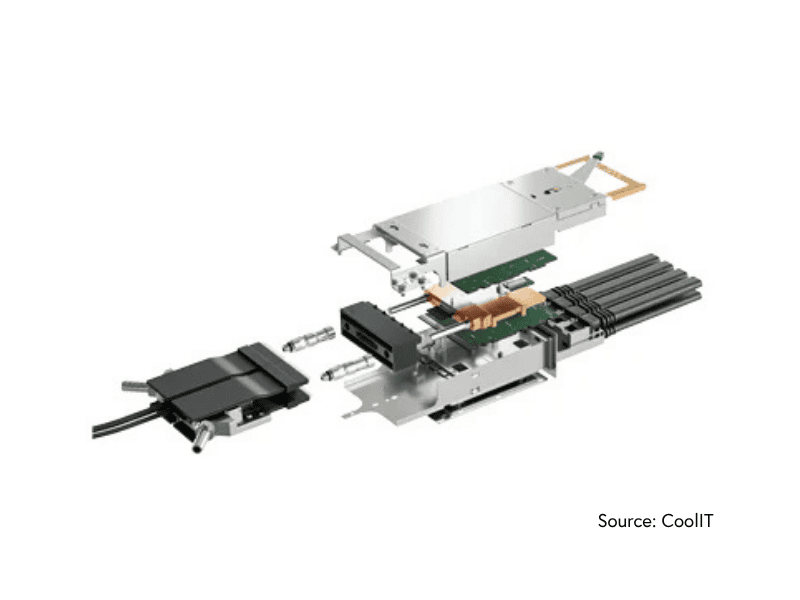
MyTechDailyNews Communications treats this eeNews Europe-related development as a signal for optical networking and data-centre teams: when AI clusters drive higher bandwidth through pluggable interfaces, the cooling challenge moves from the chassis surface into the module itself. The technical pairing described by CoolIT Systems and Stäubli centers on CoolIT’s CP-OSFP cold plate and Stäubli’s Mini Quick Disconnect, or Mini QD, a connector technology developed with Ciena.
That combination is presented as a way to manage the thermal load of next-generation OSFP optical modules while preserving serviceability in space-constrained systems.
Why this matters for communications networks in AI data centres
The source describes a practical constraint: optical interconnects must carry more bandwidth within fixed enclosure dimensions. For network engineers, this is not merely a hardware detail. It affects port layout, maintenance, and the path to higher-speed optical standards as network bandwidth advances toward 3.2 Tb/s.
The article says a typical 1RU networking system accommodates approximately 32 OSFP ports. That density limits how much additional hardware can be placed on or near the faceplate. If a cooling solution consumes too much front-space, it becomes hard to maintain the modular plug-and-play pattern that pluggable optics are valued for.
What CoolIT and Stäubli are contributing
- CoolIT Systems is represented by the CP-OSFP cold plate, a compact cold-plate design aimed at removing heat directly from optical transceivers.
- Stäubli is represented by Mini Quick Disconnect, or Mini QD, a fluid connector concept developed with Ciena to let coolant enter and exit pluggable OSFP modules with minimal faceplate footprint.
- The two elements are intended to work together as a modular cooling arrangement, transferring heat from an optical module into a broader liquid-cooling loop.
- The described connector technology targets leak-free serviceability, so modules can be installed, removed, or replaced without breaking the liquid-cooling architecture.
- The initiative also aligns with efforts toward standardised fluid interfaces for interoperable optical systems.
Brad Zakaib, CEO, CoolIT, An Ecolab Company, summarizes the positioning: “As networking optics become part of the liquid-cooling ecosystem, CoolIT’s coldplate expertise helps bring direct liquid cooling into traditionally air-cooled components. Combined with Stäubli’s Mini QD technology, we’re enabling a compact, serviceable thermal architecture for next-generation pluggable optics,”
A compact architecture for a crowded faceplate
The cold-plate description is intentionally modest: it is not presented as a large chassis cooling plant, but as a component-level path for optical modules. The design emphasis is placed on thermal performance, coolant flow distribution, reliability, and manufacturability.
For higher-power coherent optical modules, the source states that traditional air cooling is approaching practical limits. That is where direct-to-plug cooling enters: rather than relying only on airflow across the module, the proposed arrangement extracts heat at the module and routes it to the system’s liquid loop.
Mini QD matters because a cold plate alone does not solve deployment. The connector must fit in a dense front-panel environment while allowing repeatable service actions. The source frames this as a combination of compact routing and leak-free replaceability.
Comparison: air cooling, liquid cooling, and the plug-level question
| Issue raised by the source | Air-cooling context | Direct-to-plug context |
|---|---|---|
| Thermal limit | Traditional air cooling is approaching practical limits for higher-power coherent modules. | CoolIT’s CP-OSFP cold plate is designed to remove heat directly from optical transceivers. |
| Space constraint | A typical 1RU system with about 32 OSFP ports leaves little room for extra cooling hardware. | Mini Quick Disconnect, developed with Ciena, is positioned for minimal space on crowded faceplates. |
| Serviceability | Not described as the problem, but the implication is that pluggable modules must remain replaceable. | The connector technology is described as supporting leak-free serviceability during install, removal, or replacement. |
| System role | Air cooling remains the historical thermal approach for many network components. | The cold plate and Mini QD together form a modular path into a broader liquid-cooling loop. |
| Standardisation | Not framed as fluid-interface standardisation. | The development is linked to efforts toward standardised fluid interfaces for interoperable optical systems. |
Deployment checklist for network and IT teams
The source does not provide a product datasheet, but it does identify evaluation points that can be turned into a practical checklist:
- Confirm whether the optical modules are within the power class where traditional air cooling is approaching practical limits.
- Map the front-panel space budget in a 1RU system with approximately 32 OSFP ports.
- Check whether a compact cold-plate approach such as the CP-OSFP cold plate can extract heat without blocking adjacent ports.
- Evaluate the fluid interface for footprint, durability, and service access, with Mini QD and Ciena-linked development as the reference point in this report.
- Assess whether module replacement can occur without compromising leak-free operation.
- Track whether the architecture supports standardized fluid interfaces rather than a closed mechanical path.
What the data points mean
The numbers are few but useful. "3.2 Tb/s" is the bandwidth direction that the source uses to explain why thermal limits matter as optical interfaces advance. "1RU" and "32 OSFP ports" define the spatial problem: high port count in a small unit. Together, they explain why the article is not about bulk cooling, but about cooling the individual pluggable module without consuming the panel space needed for many other modules.
FAQ
Does this make optical transceivers liquid-cooled by default?
No. The source describes an approach for extending direct-to-plug liquid cooling to high-power optical transceivers in AI data centres, particularly next-generation OSFP modules. It is a proposed cooling architecture, not a universal replacement for all pluggable optics.
What role does CoolIT play?
CoolIT Systems is associated with the CP-OSFP cold plate, which is designed to remove heat directly from optical transceivers and to support thermal performance, coolant flow distribution, reliability, and manufacturability.
What role does Stäubli play?
Stäubli contributes Mini Quick Disconnect, or Mini QD, a fluid connector technology developed with Ciena. Its purpose is to let coolant enter and exit pluggable OSFP modules while occupying minimal space and supporting leak-free serviceability.
Why is Ciena mentioned?
Ciena is mentioned because Mini QD was developed with Ciena, giving the connector development a networking-equipment context. The source does not provide additional Ciena product details beyond that relationship.
Who is the original audience for this development?
The source connects it to eeNews Europe readers working in optical networking and data centre infrastructure, which makes it relevant to communications-network professionals tracking thermal limits in high-density systems.
Common misconceptions to avoid
- “Liquid cooling simply moves the problem.” The source emphasizes compactness, serviceability, and integration into the system’s liquid loop, not just heat transfer.
- “If a module is pluggable, any cooling path will be easy.” The 1RU and 32 OSFP ports example shows space and front-panel geometry are decisive.
- “Mini QD is only a connector story.” It is also tied to leak-free replaceability and potential standardised fluid interfaces.
- “CP-OSFP is only a cold-plate story.” It is presented as part of a broader architecture that includes flow, reliability, manufacturability, and serviceability.
- “Higher bandwidth alone proves air cooling has failed.” The source says air cooling is approaching practical limits for higher-power coherent modules, which is a measured technical framing, not a claim that every existing design is unusable.
Bottom line for MyTechDailyNews Communications readers
The development is useful because it identifies a boundary condition: when networking optics become part of a liquid-cooling ecosystem, the mechanical and serviceability questions become as important as the thermal question. CoolIT’s CP-OSFP cold plate and Stäubli’s Mini Quick Disconnect, or Mini QD, are positioned as a compact answer for OSFP pluggables. Network teams should track this direction without assuming immediate product availability or universal adoption, because the source gives a technical architecture, not a deployment timetable.