
Communications Briefing: Anatel Spectrum, BlueBird Gateways and Brazil's Direct-to-Smartphone Reality Check
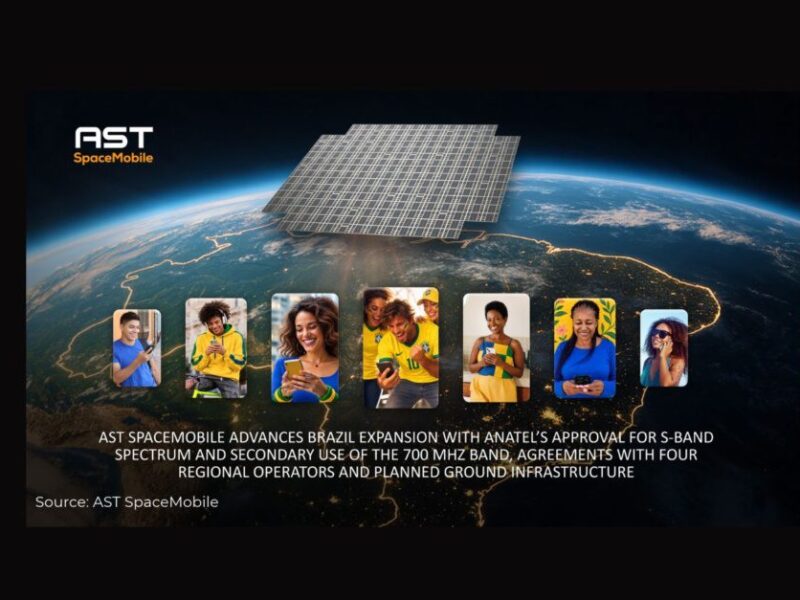
Whether satellite broadband delivered to ordinary handsets becomes a service at all is decided by three variables: spectrum, ground infrastructure and network integration. Those are exactly the variables AST SpaceMobile is now assembling in Brazil, and the resulting configuration says more about the future of coverage planning than any single launch headline. An earlier read of this sequence for eeNews Europe readers treated it as regulatory news; reframed for a MyTechDailyNews Communications audience, the same facts form a deployment project with identifiable dependencies.
Spectrum Baseline: 15+15 MHz of S-band, 30 MHz in Total
Anatel, the Brazilian telecommunications regulator, has granted the company use of 15+15 MHz of S-band spectrum, which adds up to the 30 MHz that anchors the planned service.
A second authorization sits underneath it: permission for secondary use of frequencies in the 700 MHz band. That framing matters for anyone modelling interference or hand-over behaviour, because the band is not being handled as a standalone national assignment but as a resource accessed alongside terrestrial spectrum holders.
Operator Overlay: Up to 10+10 MHz Inside Existing Licensed Areas
Following that secondary-use approval, agreements were reached with four regional mobile network operators. Each arrangement gives access to up to 10+10 MHz within the respective licensed area of the operator involved.
Put the two frequency resources together and the technical target becomes legible: voice calls, broadband data and video streaming delivered on standard, unmodified smartphones. No specialised satellite handset and no parallel device ecosystem are required, which is the condition that has historically limited the commercial reach of direct-to-device schemes.
The stated posture is additive rather than competitive. The satellite layer is meant to complement existing mobile networks, and the company intends to work with operators to carry their services into locations where conventional cellular infrastructure remains difficult to build.
Ground Segment: Four Gateways Between BlueBird and Terrestrial Networks
Frequency rights cover only part of the problem. The company is also planning four ground gateways in Brazil to interwork its BlueBird satellites with terrestrial telecommunications networks.
Through those sites, voice, video and broadband data are exchanged between the satellite constellation and the participating mobile operators. In other words, a satellite-to-handset link only becomes an actual service at the point where it interoperates with the terrestrial network.
Planning for deployment and network integration is under way. A commercial launch date has not been announced.
Coverage Economics: The Data Cited
Data reference: assessments cited by AST SpaceMobile indicate that approximately half of Brazil's federal and state highway network, and two-thirds of the land available for agricultural use in the country, sit outside 4G or 5G coverage.
That distribution — long linear corridors alongside large low-density blocks — is why a satellite operator and four regional mobile network operators are aligning resources. It is also the coverage pattern that terrestrial build-out reaches last.
Executive Position and Global Context
“Brazil's ambition for connectivity matches the scale of the country,” said Abel Avellan, founder, chairman, and CEO of AST SpaceMobile.
The four regional agreements extend operator relationships the company already held in the country. Outside Brazil, AST SpaceMobile reports partnerships with more than 60 mobile network operators that serve over three billion subscribers, and that is the baseline against which a single-market coverage project has to be judged.
Service availability remains conditioned on satellite capacity, gateway deployment, network integration, additional applicable authorizations, device compatibility and commercial arrangements.
Planning Checklist for Communications and IT Teams
- Separate what is authorized outright (15+15 MHz of S-band, 30 MHz total) from what is accessed as secondary use of the 700 MHz band.
- Map operator-held resources on their own: up to 10+10 MHz inside each of the four regional operators' licensed areas, so coverage assumptions follow those footprints rather than a national map.
- Treat the four planned ground gateways as interconnection projects, not construction projects — gateway-to-network integration is where service definition actually happens.
- Validate device assumptions against the stated target: standard, unmodified smartphones.
- Keep the dependency list attached to any coverage claim, since no commercial launch date has been announced.
Terrestrial RAN vs Satellite Direct-to-Phone Layer
| Design dimension | Existing terrestrial mobile network | Planned satellite direct-to-phone extension |
|---|---|---|
| Role in service design | Primary layer where infrastructure already exists | Extension of existing 4G and 5G services beyond terrestrial coverage |
| Spectrum basis | Licensed assignments held by operators, including the 700 MHz band | 15+15 MHz of S-band (30 MHz total) plus secondary 700 MHz use and up to 10+10 MHz via four regional operators |
| Device requirement | Standard smartphones | Standard, unmodified smartphones; no specialised satellite handset |
| Interface point | Radio access network feeding operator services | Four planned ground gateways linking BlueBird satellites with terrestrial telecommunications networks |
| Traffic carried | Voice calls, broadband data, video streaming | Voice, video and broadband data exchanged with participating mobile operators |
| Status | Deployed and operating | Gateway deployment and network integration in planning; no commercial launch date announced |
Common Misconceptions
- The satellite layer replaces terrestrial cells. The described approach is complementary: operators' services are extended into locations where conventional cellular infrastructure is still difficult to build.
- Spectrum approval equals a service. Satellite capacity, gateway deployment, network integration, further authorizations, device compatibility and commercial arrangements all sit on the critical path.
- The 700 MHz access is a licence of its own. It is authorization for secondary use, operationalized through agreements with four regional mobile network operators.
- Direct-to-phone requires special handsets. The stated design target is standard, unmodified smartphones.
FAQ
What has actually been authorized in Brazil?
Anatel has granted 15+15 MHz of S-band spectrum, a total of 30 MHz, along with authorization for secondary use of frequencies in the 700 MHz band.
How much operator spectrum is in scope?
Up to 10+10 MHz, secured through agreements with four regional mobile network operators and available within their respective licensed areas.
Which services are being targeted?
Voice calls, broadband data and video streaming on ordinary smartphones, positioned as an extension of 4G and 5G coverage rather than a stand-alone offering.
How large is the coverage problem being addressed?
According to assessments cited by AST SpaceMobile, roughly half of the federal and state highway network and two-thirds of agriculturally usable land lack 4G or 5G coverage.
Is there a service start date?
No commercial launch date has been announced. Current planning covers deployment of the four ground gateways and integration with participating operators' networks.
For teams that own coverage plans, the value of this sequence is procedural: it shows the order in which a direct-to-device project has to be assembled — paired spectrum first, operator-held frequencies second, gateway interworking third. How quickly satellite broadband on unmodified handsets reaches customers in Brazil follows from those three steps.